"93 Million Miles, and Not One Through the Strait of Hormuz"
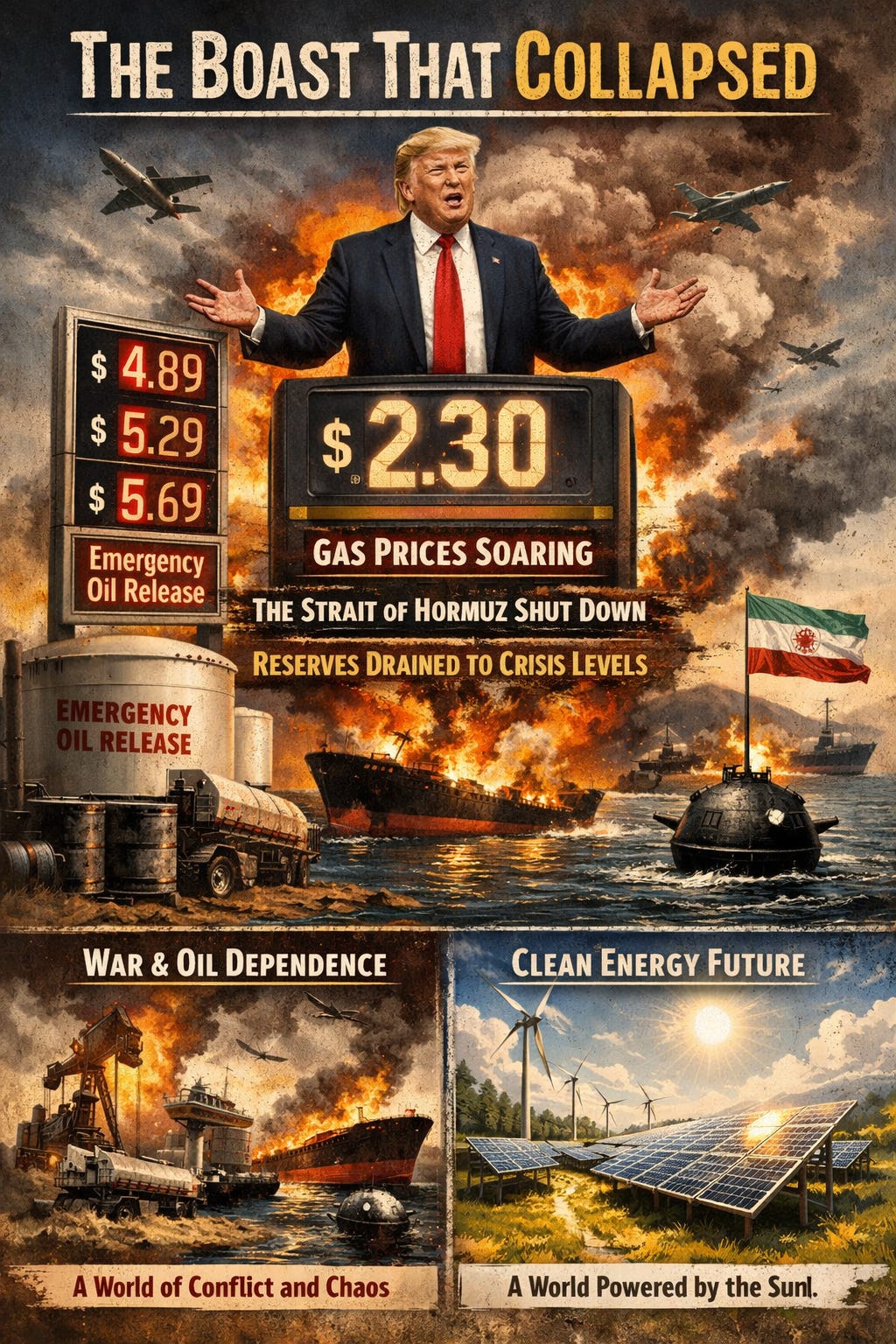
Here’s One Boast Trump Won’t Be Making Anymore
If it seems confounding that a president would start a war that’s guaranteed to raise the prices he had repeatedly vowed to lower, well, it’s not the first time, because the Trump administration was already doing battle against the single surest path to cheaper energy: renewables.
… Mr. Trump, however, dismisses these industries as “con jobs,” insisting that wind turbines drive whales crazy, kill birds and cause cancer, and that solar power destroys farmers’ livelihoods. “We’re going to try and have a policy where no windmills are being built,” he vowed shortly before his inauguration.
New York Times Guest Essay March 11, 2026
and
“Sunlight travels 93 million miles to reach the earth, None of them through the Strait of Hormuz” - Bill McKibben
in CounterCurrents.org in Climate Change by Bill McKibben July 3, 2026
1224 words Reading Time 5 Minutes
Donald Trump built his second term on a single economic boast: cheap gasoline. He ran on it, campaigned on it, and stood at the State of the Union podium last month to tell the country that gas had fallen to $2.30 a gallon in most states. Republicans heading into the 2026 midterms had been rehearsing the same line for months.
That boast, as the New York Times noted on March 11th, is one he won’t be making anymore.
Twelve days into the war he chose to start against Iran, the national average price of gasoline has surged by nearly 60 cents a gallon. The Strait of Hormuz — the chokepoint through which roughly twenty percent of the world’s oil supply passes every day — has been effectively shut down by Iranian mines and collapsing shipping confidence. The Strategic Petroleum Reserve, already near historic lows, is being drained at emergency rates. And the president who spent fourteen months systematically destroying America’s clean energy future is left defending a war that has turned his signature economic achievement to ash.
The lesson was written most clearly in July by climate writer Bill McKibben: “sunlight travels 93 million miles to reach the earth, and none of them go through the Strait of Hormuz”.
The Most Fragile Machine in History
We are so accustomed to the fossil fuel system that we no longer see how extraordinarily fragile it is. Getting a gallon of gasoline into your car requires drilling — increasingly a mile beneath the sea floor, or by fracturing underground geology and triggering earthquakes. The crude then travels through pipelines prone to leaks, onto tankers that must navigate narrow chokepoints where the entire global supply can be held hostage by a naval mine. At its destination, it goes to a refinery — among the most complex machinery ever built — then by truck to gas stations where it sits in underground tanks that quietly contaminate groundwater. Finally, it burns in an engine with hundreds of thousands of moving parts that wastes roughly 75 percent of the fuel’s energy as heat and noise.
Every link in that chain is a potential point of failure. Right now, one of them is broken.
The Strait of Hormuz handles roughly 20 million barrels per day. Iran has mined it. Maersk and Hapag-Lloyd have suspended transits. Tanker traffic has fallen from around 50 ships daily to effectively zero. The Trump administration has reached for the Strategic Petroleum Reserve — the same stockpile Trump spent years attacking Biden for touching — and the International Energy Agency has organized a coordinated global release. These are emergency measures, not policy tools. They are exactly what oil dependency was always going to look like under pressure.
What Trump Spent a Year Destroying
The contrast with Trump’s energy policy could not be more brutal.
His “One Big Beautiful Bill,” signed on July 4th, 2025, ended the federal solar tax credit for homeowners, accelerated the phase-out of wind and solar project credits, and eliminated the EV purchase credit. His administration clawed back billions in Inflation Reduction Act grants, froze clean energy funding, and slow-walked court orders to restore it. It withdrew from the Paris Agreement and proposed repealing the EPA’s foundational legal determination that greenhouse gases harm human health — making climate denial official federal policy for the first time.
The Center for American Progress estimated households are facing a 9.6% increase in electricity bills in 2025 compared to 2024, outpacing inflation and wage growth. The administration dismissed those numbers as alarmism about “wasteful green subsidies.” Now, with gas prices rising weekly and the reserve being drained, those numbers look different.
Every dollar Trump spent fighting clean energy was a dollar spent making America more dependent on exactly the kind of supply that can be disrupted by a few thousand dollars’ worth of naval mines.
The War-Proof Alternative
McKibben’s piece places the fossil fuel supply chain beside the solar one and simply lets you look at both.
The solar supply chain is almost absurdly simple. Photons leave the sun, travel 93 million miles in about eight minutes, strike silicon in a panel, knock loose electrons, get converted to AC power, and flow into a battery or motor. About 20 moving parts total. Eighty to ninety percent efficient. No exhaust, no carbon dioxide, almost no noise.
No drilling. No pipeline. No tanker. No refinery. No underground storage tank. No 75 percent energy waste.
And — the line that deserves to be printed above every energy secretary’s desk — no one can use a missile to shoot down a photon in mid-air. Solar energy is, in McKibben’s phrase, essentially war-proof. You can generate it on your roof, your balcony, or in your community. It requires no oligarch, no naval escort, no strategic chokepoint. It would impoverish Vladimir Putin and Mohammed bin Salman. McKibben notes dryly that this is precisely why the people with the power to accelerate its adoption have spent decades choosing not to.
The Trump administration is expected to ask Congress for $50 billion in supplemental war funding this week — roughly $2 billion a day in military spending. The World Bank estimates that bringing solar power to the 380 million Africans currently without electricity would cost about $91 billion. The math is not complicated. It is simply politically inconvenient for those who have staked their careers on keeping the old machine running.
The Boast That Collapsed
An NBC News poll last weekend showed Trump’s approval on inflation and cost of living at just 36 percent. Fifty-four percent disapprove of his handling of the Iran war. One oil analyst told CNN simply: “Words aren’t going to talk oil prices back to normal.” Even after the conflict ends, elevated prices are expected to persist for months as production recovers and risk premiums linger.
Trump posted on Truth Social that “when oil prices go up, we make a lot of money.” It is a remarkable thing for a president to say during an energy crisis his own decisions created, while millions of Americans pay more at the pump every week. It reveals the worldview behind all of it: the belief that fossil fuel is not merely an energy source but an identity, a loyalty — and that protecting it is worth any cost, including the wars required to defend the chokepoints through which it flows.
There is another way. It has been available for decades. It gets cheaper every year. It cannot be mined, blockaded, or held hostage by any government or supreme leader.
The sun will be up tomorrow. It always is. And not one of those 93 million miles will pass through the Strait of Hormuz.
Sources: Bill McKibben, “Sunlight travels 93 million miles to reach the earth, None of them through the Strait of Hormuz,” CounterCurrents.org / The Crucial Years, March 6–7, 2026. “Here’s One Boast Trump Won’t Be Making Anymore,” New York Times guest essay, March 11, 2026. AAA gasoline price data, March 2026. Center for American Progress IRA rollback cost analysis. World Bank solar access estimates. NBC News / CNN / Bloomberg reporting on the 2026 Strait of Hormuz crisis.
FTS
Join us on our podcast Specifically for Seniors, where satire meets substance and storytelling sparks civic engagement. Each episode dives into topics like authoritarianism, political spectacle, environmental justice, humor, history and even fly fishing and more—layered with metaphor, wit, and historical insight. We feature compelling guest interviews that challenge, inspire, and empower, especially for senior audiences and civic storytellers. Listen to the audio on all major podcast platforms, watch full video episodes on YouTube, or explore more at our website.
Let’s keep the conversation sharp, smart, and unapologetically bold