An Open Letter to President Trump
Word Count: ~1925 Reading Time: ~8.5 Minutes
MARCH 26, 2026
TO: PRESIDENT DONALD J. TRUMP·
THE WHITE HOUSE,
WASHINGTON D.C.
Mr. President,
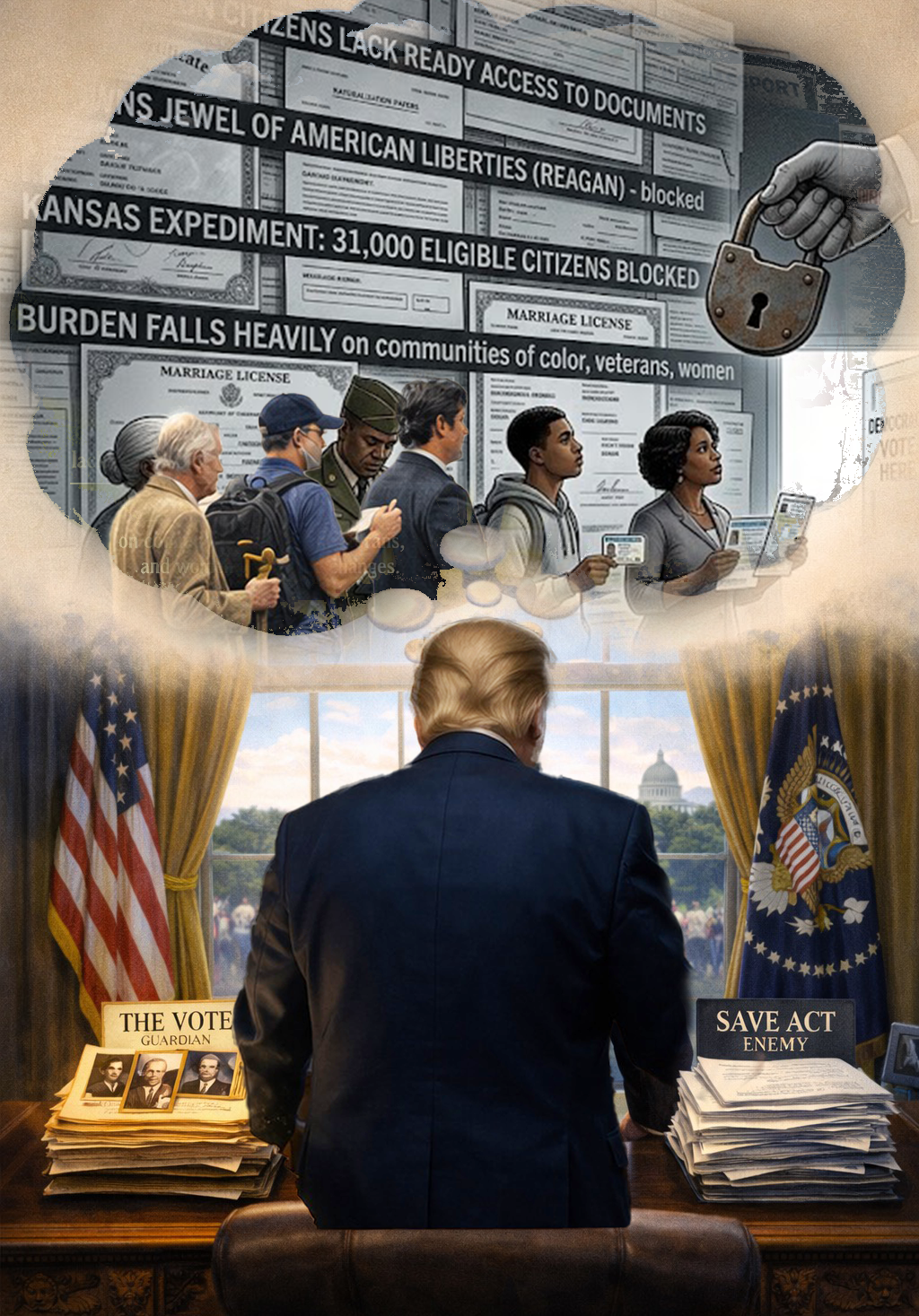
Mr. President, there is a question that every occupant of the office you now hold has eventually been forced to answer — not by Congress, not by the courts, but by history itself: Did you protect the right of every American to vote, or did you not? The men who answered that question well are remembered as guardians of democracy. The men who answered it poorly are remembered as its enemies. You are now standing at that crossroads, and the SAVE Act is the road sign pointing in the wrong direction.
This is not a partisan letter. It is an American one. It is written in the tradition of citizens who have watched their presidents — of both parties — rise to meet the defining moral obligations of their time, or fail to do so. And it is written in the urgent belief that you still have a choice, and that the choice you make will define you long after the politics of this moment have faded from memory.
The presidents who preceded you were not uniformly perfect men. But on the question of voting rights, the best of them spoke with a clarity and moral force that cut across party lines and across generations. Thomas Jefferson called the vote “the ark of our safety.” Abraham Lincoln declared that “the ballot is stronger than the bullet.” Franklin Roosevelt warned that “nobody will ever deprive the American people of the right to vote except the American people themselves and the only way they could do this is by not voting.” John F. Kennedy reminded us that the ignorance of even one voter imperils the freedom of all.
And then there was Lyndon Baines Johnson — a Southern Democrat, a complicated man of enormous appetites and enormous ambition — who on the night of March 15, 1965, stood before a joint session of Congress and delivered the most consequential address on voting rights in the history of the American presidency. His speechwriter, the brilliant Richard Goodwin, had stayed up through the night, pecking out the words on a manual typewriter, driven by moral clarity.
LYNDON B. JOHNSON — “WE SHALL OVERCOME” — MARCH 15, 1965
“Our fathers believed that if this noble view of the rights of man was to flourish, it must be rooted in democracy. The most basic right of all was the right to choose your own leaders. The history of this country, in large measure, is the history of the expansion of that right to all of our people. Many of the issues of civil rights are very complex and most difficult. But about this there can and should be no argument.
Every American citizen must have an equal right to vote.
There is no reason which can excuse the denial of that right. There is no duty which weigh more heavily on us than the duty we have to ensure that right.”
ADDRESS TO A JOINT SESSION OF CONGRESS · EIGHT DAYS AFTER BLOODY SUNDAY, SELMA, ALABAMA
Seventy million Americans watched that speech on television. They had already seen the footage from the Edmund Pettus Bridge — the clubs, the tear gas, the state troopers on horseback running down peaceful marchers who asked only for the right to cast a ballot. Johnson looked into that national wound and declared it everyone’s wound. He adopted the anthem of the civil rights movement as his own. He made the cause of Black Americans the cause of all Americans. Senators who had fought him for years rose to their feet and wept.
Five months later, he signed the Voting Rights Act into law. It abolished poll taxes and literacy tests. It mandated federal oversight of states with histories of suppression. It was the fulfillment of a promise that the Constitution had made a century earlier and that a century of obstruction had delayed. Reagan later called the vote “the crown jewel of American liberties.” Barack Obama called it “one of the most fundamental, sacred rights of any democracy.”
Mr. President, these were your predecessors. This is the tradition into which the Oval Office initiated you. And this is the standard against which the SAVE Act will be judged.
The Safeguard American Voter Eligibility Act is presented as a defense against noncitizen voting. But the evidence it is meant to address is essentially nonexistent. Utah spent months reviewing its entire voter registration list of more than two million people. They found one — one — confirmed noncitizen registration, and zero instances of a noncitizen actually casting a ballot. Federal records show that just 0.04% of voter verification cases flag potential noncitizens, and even many of those turn out to be errors. The problem the SAVE Act claims to solve does not exist at any scale that justifies what it would do to the American electorate.
“The SAVE Act would not prevent a single fraudulent vote the evidence suggests would be cast. What it would do is lock millions of legitimate Americans out of democracy.”
-U.S. Representative Joseph D. Morelle (D-NY)
What it would do — what it is already designed to do — is impose a documentary burden on voter registration that tens of millions of Americans cannot easily meet. More than 21 million citizens lack ready access to a passport or an original birth certificate. Millions of American women whose married names differ from their birth documents would face extra bureaucratic hurdles simply to exercise a right the Constitution guarantees them. Election officials who register even one unverified applicant face up to five years in federal prison — a criminal threat so severe it will terrify local officials into turning away legitimate voters rather than risk prosecution.
Citizens of color are three times more likely than white citizens to lack ready access to birth certificates, passports, or naturalization papers — meaning the SAVE Act’s burden falls heaviest on the communities whose votes history has already spent centuries trying to suppress.
We have a warning from history here, too. Kansas enacted a documentary proof requirement years before the SAVE Act was proposed. Noncitizen registration in Kansas was already vanishingly rare — about 0.002% of registered voters. After the law took effect, roughly 31,000 eligible citizens — 12% of all applicants — were blocked from registering. Twelve percent of citizens. To stop a fraction of a fraction of a percent of potential noncitizens. The Kansas experiment did not protect democracy. It dismantled a piece of it.
And who bears that burden? Not the wealthy. Not those with lawyers and accountants and filing systems and passports kept in fireproof safes. The burden falls on the young voter registering for the first time at a campus voter drive. It falls on the elderly woman whose birth records were kept by a county courthouse that burned down decades ago. It falls on the veteran’s family that has moved four times in five years following military assignments. It falls on the family still trying to rebuild after a hurricane took everything, including their papers. It falls on the married woman whose name on her birth certificate no longer matches the name on her driver’s license. These are not abstractions, Mr. President. These are Americans.
Mr. President, you took an oath to preserve, protect, and defend the Constitution of the United States. That Constitution, in its Fifteenth, Nineteenth, and Twenty-Fourth Amendments, forbids the denial of the vote on account of race, sex, or inability to pay a poll tax. The Supreme Court has affirmed, repeatedly, that the right to vote is the foundation upon which all other constitutional rights depend. You did not swear to protect the right of some Americans to vote. You swore to protect the right of all of them.
“I want to be the president who protected the right of every citizen to vote in every election.”
— LYNDON B. JOHNSON, MARCH 15, 1965
Johnson said that. He meant it. And history has honored him for it, even as it holds him accountable for the failures of Vietnam. The presidency is a ledger, Mr. President, and voting rights occupy a line that does not balance against anything else. You cannot trade them for political advantage and come out ahead in the long accounting of history.
The timing of the SAVE Act’s push — pressed urgently ahead of the 2026 midterm elections, with you declaring you would sign no other legislation until it passed — makes the political calculation transparent. But transparency in motive is not a defense. The literacy tests of the Jim Crow South were also transparently political. The poll taxes were also transparently political. They were struck down not because their politics were exposed, but because they violated an American principle that supersedes politics: that in this republic, the government does not get to choose who votes by making voting too difficult for the inconvenient.
We are not asking you to abandon the idea of election integrity. Election integrity is a legitimate and important goal, and there are real ways to pursue it — ways that do not require building walls between millions of citizens and their ballots. Modernize voter rolls through data-sharing agreements. Fund local election offices. Prosecute the rare, actual cases of fraud when they occur. But do not demand that Americans produce documentary proof of citizenship that millions of them cannot readily access, enforced by criminal penalties so severe that election officials will be afraid to do their jobs.
We are asking you to remember that the presidency is larger than any election cycle. The men whose names are carved into the monuments on the Mall did not build those legacies by asking what suppressing certain votes would do for them in the next election. They asked what their moment in history required of them. Some of them answered that question better than others. But on the question of voting rights, the direction of the American story has always — despite obstruction, despite regression, despite the worst impulses of the powerful — bent toward more voices, not fewer. Toward a wider democracy, not a narrower one.
THE STANDARD EVERY PRESIDENT INHERITS
“This right to vote is the basic right without which all others are meaningless. It gives people — people as individuals — control over their own destinies.”
— PRESIDENT LYNDON B. JOHNSON, AT THE SIGNING OF THE VOTING RIGHTS ACT, AUGUST 6, 1965
That is the standard, Mr. President. Not ours — Johnson’s. And Reagan’s. And Jefferson’s. And Lincoln’s. The standard is unanimous across two and a half centuries of American presidents, across party lines, across regions, across eras of prosperity and crisis: the right to vote belongs to every citizen, and the duty of the president is to protect it.
You still have the power to decide which side of history you stand on. You can withdraw your support for the SAVE Act and direct your administration to pursue election security through means that do not disenfranchise millions. You can stand before the American people and say what Lyndon Johnson said — that their cause is your cause. That you will not allow the machinery of government to be used against the very citizens it exists to serve. That the right to vote is, in Ronald Reagan’s words, “the crown jewel of American liberties,” and that its luster will not be diminished on your watch.
Sixty years ago, a president from Texas looked at a nation that had just watched peaceful people beaten on a bridge for wanting to vote, and he chose to be remembered as the man who ended that. The choice before you is not so different. The methods of suppression have been modernized. The principle at stake has not changed one word.
History is not a future abstraction. It is being written right now, in this Congress, in this administration, by the choices being made in your name. We urge you — as citizens, as Americans, as inheritors of the same democratic tradition that produced the men you have cited and honored — to make the choice that history will not have to apologize for.
We shall overcome was not merely a lyric. It was a promise. It was a promise made by every American who ever marched, or organized, or simply walked into a polling place and waited in line and cast a ballot in the faith that it would count. That promise does not expire. And no act of Congress, however cleverly named, has the power to make it go away.
Respectfully, urgently, and on behalf of every American whose voice depends on a ballot that is never made impossible to cast —
The American People
Author’s Note: Every effort was made to ensure that quotations were correctly attributed. Please excuse any errors, but quotes were checked as accurately as possible.
Join us on our podcast Specifically for Seniors, where satire meets substance and storytelling sparks civic engagement. Each episode dives into topics like authoritarianism, political spectacle, environmental justice, humor, history and even fly fishing and more—layered with metaphor, wit, and historical insight. We feature compelling guest interviews that challenge, inspire, and empower, especially for senior audiences and civic storytellers. Listen to the audio on all major podcast platforms, watch full video episodes on YouTube, or explore more at our website.
Let’s keep the conversation sharp, smart, and unapologetically bold