Design Panel Proposes “More Fitting” Obverse for Presidential Commemorative Coin
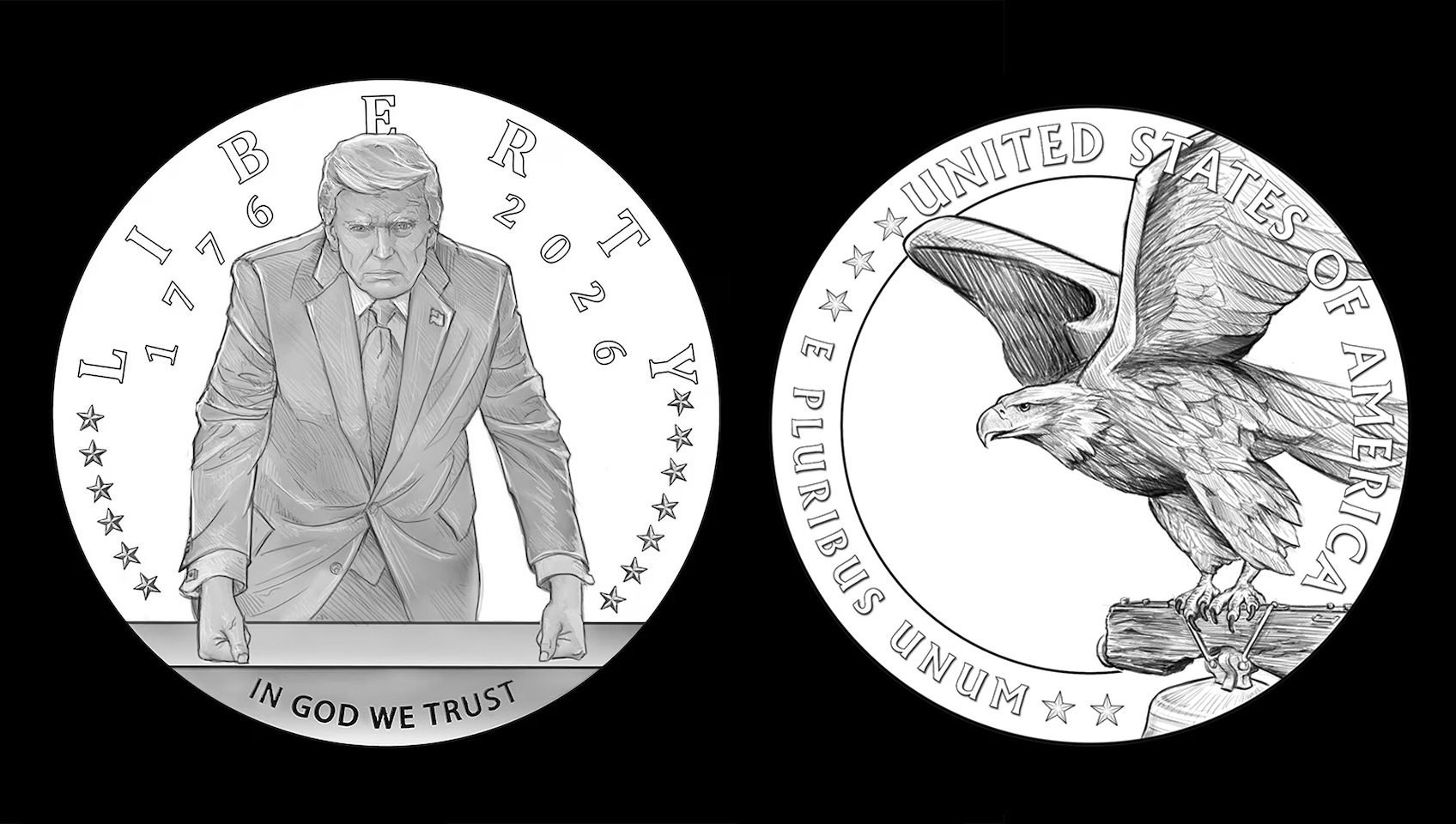
The message on Trump’s coin is clear. And it’s chilling.
Julius Caesar also broke with tradition by putting himself on a coin. It didn’t go over so well.
The Trump gold coin would be issued under the U.S. Mint’s authority to create gold coins and silver medals without explicit congressional authorization. But its use of a portrait of the 47th president is an extraordinary break with centuries of democratic aversion to depicting living presidents on the nation’s money.
Washington Post March 20, 2026
The Rutabaga Register
NUMISMATICS • NATIONAL VANITY • HORSE SENSE
Design Panel Proposes “More Fitting” Obverse for Presidential Commemorative Coin
Federal arts committee rejects Trump portrait, unanimously endorses alternative imagery it calls “historically honest, anatomically accurate, and frankly rather majestic.” Eagle reportedly on board. Horse unavailable for comment.
by Cornelius P. Wheatstraw
Senior Bullion Correspondent • Washington Bureau
March 22, 2026
1,185 words 5 min. read
WASHINGTON — In what numismatic historians are already calling “the most consequential rear-end decision since the mule was put on the 1913 Liberty Head nickel,” a dissident faction of coin-design experts has submitted an unsolicited counter-proposal to the United States Mint, suggesting that the approved obverse for the upcoming $9,000 commemorative gold coin be replaced with an image they describe as “more symbolically coherent, less constitutionally alarming, and considerably better-looking.”
The proposal, catalogued under the designation SemiQ-G-R-01, depicts the rear end of an American quarter horse — mane flowing, tail triumphant, an eagle perched upon its back with wings spread in what the committee’s accompanying letter calls “a posture of dignified exasperation.” The design was submitted to the Mint on Friday afternoon, approximately forty-eight hours after a hand-picked federal arts commission voted unanimously to approve a portrait of President Donald J. Trump — fists planted on a desk, expression set to “permanent customs dispute” — for the obverse of a 24-karat gold coin commemorating the nation’s 250th anniversary.
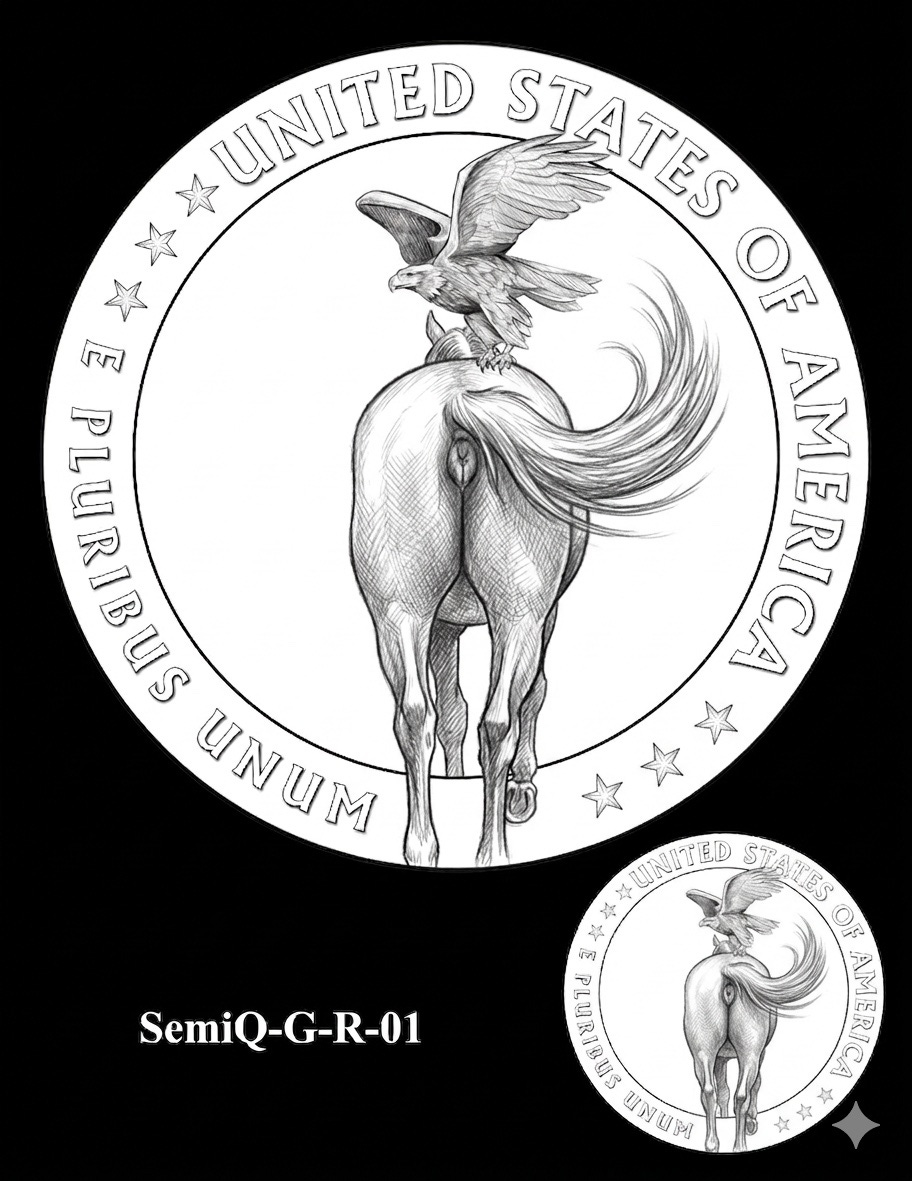
The alternative obverse design, designated SemiQ-G-R-01, as submitted by the Independent Committee for Numismatic Propriety and Horse-Based Symbolism. An American quarter horse, viewed posteriorly, with a bald eagle perched atop. Inscriptions read United States of America and E Pluribus Unum. The design received a standing ovation at the committee’s emergency plenary session, held in a Denny’s parking lot in Arlington, Virginia.
“The message,” wrote committee chair Dr. Lavinia Copperbottom-Finch in the group’s cover letter, “is one of unity, forward motion, and the acknowledgment that leadership, like a horse, is most usefully evaluated from all angles. The eagle, we feel, represents the federal government’s characteristic posture: technically in charge, clearly along for the ride, and doing its level best not to fall off.”
The approved Trump coin, by contrast, features the 47th president rendered in the style of a photograph by Daniel Torok that now hangs in the Smithsonian National Portrait Gallery — a portrait, critics have noted, that makes the president look as though he has just been informed that someone left the refrigerator door open in the West Wing. The reverse depicts a bald eagle atop a perch, glaring outward with an air of grim institutional loyalty.
“Julius Caesar was the first living Roman to put his image on a coin. We’re just saying. We’re not saying anything. We’re just saying.”— COMMITTEE FOOTNOTE, PAGE 4
The Commission of Fine Arts, whose members were described by one Washington Post critic as “now stacked with Trump loyalists,” approved the original design without a single objection to the symbolism, the legality, or the centuries-long democratic tradition being cheerfully trampled underfoot. Treasury Secretary Brandon Beach called the president’s profile “no profile more emblematic” for such a coin, a sentence which the Rutabaga Register’s Style Desk is still diagramming for grammatical coherence.
Experts in classical history have been brisk in their commentary. Numismatist Caroline Turco of the American Numismatic Association’s Money Museum noted that coinage is among the oldest and most effective forms of political messaging, adding that when ancient rulers stamped their faces on money, citizens were compelled to carry the image in their pockets, hand it to merchants, pass it to their children. “It’s compliance made tactile,” she said. “You can disagree with the king all you like at dinner. But at the market, you hand over his face.”
The Roman historian Cassius Dio listed Caesar’s coin among his most egregious acts of self-aggrandizement. He noted, pointedly, that it was the Senate itself that had enabled the whole project — that no tyrant rises entirely alone. “It was the senators themselves,” Dio wrote, “who had by their novel and excessive honours encouraged him and puffed him up.” At Thursday’s Commission meeting, no member raised an objection.
HISTORICAL PRECEDENT: A BRIEF AND CAUTIONARY TABLE
44 B.C., Julius Caesar: Face on coin. Declared “Dictator Perpetuo.” Dead by March. Mixed legacy, mostly downward.
1926, Calvin Coolidge: Appeared alongside George Washington on commemorative half dollar. Heavily criticized. Later presided over the run-up to the Great Depression, so: also mixed legacy.
2026, Donald J. Trump: Face on 24-karat gold commemorative coin. Story ongoing. Eagle reportedly nervous.
The Trump administration has argued that the Treasury Secretary holds statutory authority to authorize certain commemorative coins outside the normal legislative process, citing Section 5112 of Title 31 of the U.S. Code and the Circulating Collectible Coin Redesign Act of 2020. Legal scholars have noted this sidesteps — though perhaps does not technically violate — longstanding prohibitions against placing the likeness of living persons on U.S. currency. Critics call it a loophole. Supporters call it leadership. The Rutabaga Register calls it extremely on-brand.
The alternative design committee’s proposal was filed under the provisions of Wishful Thinking, Subsection: Worth a Shot. Dr. Copperbottom-Finch confirmed that the horse in the illustration was not a specific horse, but rather a composite ideal — “Every horse,” she wrote, “that ever carried the weight of history without once asking for its own portrait on legal tender.”
The eagle, she added, was modeled on no particular eagle. But she noted that it looked, in the artist’s sketch, as though it understood completely what it had gotten itself into and had made peace with the situation in the manner of all great national symbols: by fixing its gaze somewhere distant, spreading its wings, and letting the horse do the walking.
The U.S. Mint did not respond to a request for comment on the counter-proposal. A spokesperson for the Commission of Fine Arts replied with a statement reading, in full: “We have not received any submission designated SemiQ-G-R-01.” This is technically true, as the committee mailed it via USPS standard class and it has not yet arrived.
The commemorative gold coin, once minted, is expected to retail for a significant premium over the spot price of gold, which as of this writing stands at approximately $3,000 per troy ounce. A coin commemorating national ideals, the dignity of self-governance, and the solemn passage of 250 years of republican tradition will thus be available for purchase by those with sufficient discretionary income, which the committee notes is itself a kind of message.
The horse was unavailable for comment. The eagle declined to be quoted directly but was seen, late Friday, perched on a fence post outside the Bureau of Engraving and Printing, looking, witnesses said, “thoughtful.”
THE RUTABAGA REGISTER • WASHINGTON, D.C.
SATIRE. OBVIOUSLY. PLEASE.
FTS
Join us on our podcast Specifically for Seniors, where satire meets substance and storytelling sparks civic engagement. Each episode dives into topics like authoritarianism, political spectacle, environmental justice, humor, history and even fly fishing and more—layered with metaphor, wit, and historical insight. We feature compelling guest interviews that challenge, inspire, and empower, especially for senior audiences and civic storytellers. Listen to the audio on all major podcast platforms, watch full video episodes on YouTube, or explore more at our website.
Let’s keep the conversation sharp, smart, and unapologetically bold