Gulliver's Washington
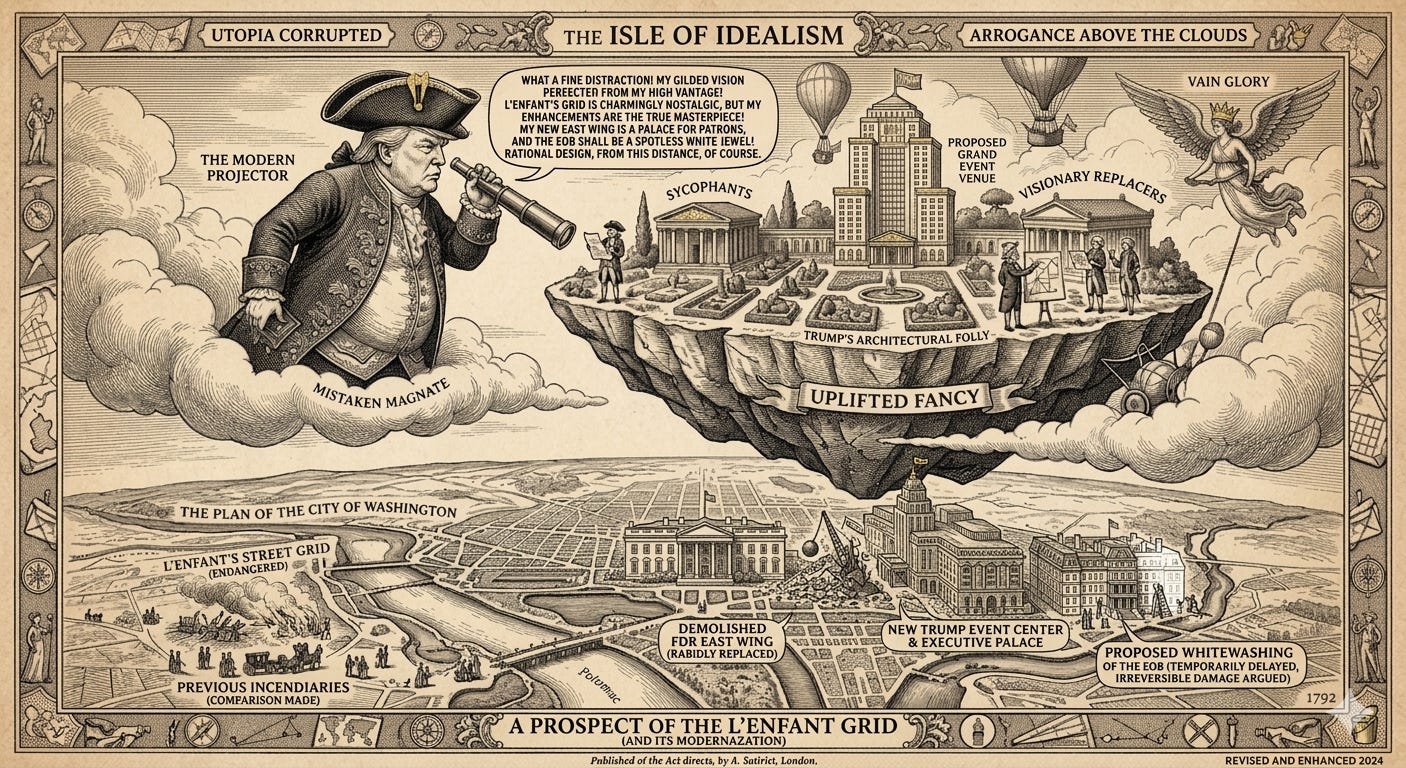
Trump is the biggest threat to D.C.’s architectural splendor since War of 1812
Trump is the most significant threat to the city’s architectural and design legacy since British forces burned the Capitol and White House during the War of 1812. He has already demolished the East Wing of the White House, which dates to the administration of Franklin D. Roosevelt. He will replace it with a building that makes James Hoban’s neo-Classical executive mansion a mere appendage to a space meant to function like a hotel-convention-center-entertainment venue. He has proposed (but temporarily delayed) painting the next-door Eisenhower Executive Office Building a blinding shade of white, which preservation groups argue could irreversibly damage the stone facade.
Washington Post March 23, 2026
Word Count: ~900 words Reading Time: ~3.5 minutes
Swift in Washington: From Lilliput to Laputa
Jonathan Swift published Gulliver’s Travels in 1726, but he seems to have had a mole in the current White House. The book charts a voyage from the ridiculous to the grandiose — from a land of tiny, vain, squabbling people obsessed with their own magnificence, to a flying island ruled by men whose heads are literally in the clouds, crushing whatever lies beneath them. Three centuries later, the journey maps with uncomfortable precision onto what the Washington Post last week called the biggest threat to Washington’s architectural splendor since the British burned it in 1814.
Start with the Lilliputians, and start with their most famous quality. They are small — not merely in stature but in every way that counts. They appoint courtiers not by merit but by their ability to dance on a tightrope. They wage war on a neighboring empire over which end of an egg to crack. They bestow titles and colored ribbons in solemn ceremonies of exquisite, comic meaninglessness. Swift’s joke is that the Lilliputians don’t know they’re small. They experience themselves as mighty. Their pride, as one Swift scholar has put it, should be commensurate with their size — and it never, ever is.
Here is a man who has spent decades slapping his name on buildings in gold letters, who grades his life’s work by crowd size and cable news coverage, who competes in his own mind with every great structure on earth. When presented with plans for a triumphal arch near the capital’s historic center, he told reporters: “We’re building an arch like the Arc de Triomphe, and it’s something that is so special. It will be like the one in Paris, but, to be honest with you, it blows it away.” The Lilliputian emperor, readers will recall, was also a man of commanding presence and regal bearing — vain, corrupt, obsessed with ceremony, constitutionally incapable of perceiving the gulf between his self-image and his actual stature. He too awarded meaningless ribbons to cronies. He too measured greatness in spectacle. He too would have found the Arc de Triomphe insufficiently large.
But Lilliput is only the opening act. Swift builds deliberately. The Lilliputians are small and vain. The Laputans are something worse: powerful, untethered from reality, and actively destructive to the world beneath them.
In Part III of Gulliver’s Travels, the flying island of Laputa hovers above its subject territory of Balnibarbi, casting it in shadow. The island’s rulers are not stupid exactly — they are, in their fashion, deeply learned. They theorize endlessly about music and mathematics and architecture. But their learning has curdled into something useless and dangerous in equal measure. Their projectors — the visionary improvers who descend to the land below — tear down functioning farms and villages to replace them with grand experimental systems that never work, leaving rubble in their wake. They ruin their farms attempting to extract sunbeams from cucumbers. The Laputans don’t build; they impose. They don’t consult; they hover. When a territory displeases them, they simply drop the island on it.
In recent months, the real-estate developer turned president has torn down the East Wing of the White House to build a flashy $400 million ballroom, added his name to the façade of the Kennedy Center for the Performing Arts, suggested painting the Eisenhower Executive Office Building all white to “beautify” it, and pushed plans to build an enormous triumphal arch near the capital’s historic center. He did this at Laputan speed and with Laputan indifference to everything already standing. Preservationists witnessed the East Wing demolished in October without warning, approval from federal agencies, or any public input. The Laputans, too, did not seek public input. The island moved when the king wished it to move.
The proposed Independence Arch would stand 250 feet tall — the height of a 16- to 20-story building — positioned directly between Arlington National Cemetery and the Lincoln Memorial, drastically obstructing the view between them. That sightline is not accidental. It is a deliberate axis — a symbolic passage connecting reunion and sacrifice, Lincoln to Lee’s house, spanning the Potomac — planned and preserved across generations. The Laputan king would understand the impulse perfectly: why maintain an unobstructed view carrying two centuries of civic meaning when you could block it with something enormous and personally branded?
Trump’s drive to attach his name to buildings is characteristic but unprecedented for a president, extending a career-long practice of branding modernist skyscrapers into structures of historic and civic significance. In Laputa, architecture exists to reflect the ruler’s vision. In L’Enfant’s Washington — the Washington that has survived wars, riots, and two centuries of political ambition — it exists to reflect the republic. The distinction is not merely aesthetic. It is the difference between a democracy and an authoritarian state, expressed in stone and sightlines. As one architectural historian has noted, “We’re really in unprecedented territory, and there’s a ton of uncertainty. And it seems like it gets more uncertain every day.”
Which brings us to the part Swift never wrote, because he couldn’t quite have imagined it.
Swift’s projectors were, at their core, misguided visionaries. They had looked outward and upward — toward abstraction, toward theory, toward the sky — and lost contact with the ground. Their tragedy was elevation. They genuinely believed, from their great height, that they were improving things.
What Washington is contending with is something else entirely. This is not a leader whose gaze has drifted skyward into clouds of theory and ambition. This is a leader whose gaze has never left himself — folded entirely inward, navigating by the dim light of his own ego, unable to perceive any structure, symbol, or sightline that doesn’t begin and end with his own reflection. The Laputans were deluded by abstraction. This is delusion of a more cramped and personal variety: the grandiose projects of a man who has, in every meaningful sense, mistaken the inside of his own vanity for the outside world.
Swift sent Gulliver on voyages to understand the full spectrum of human folly — from the pettiness of great men to the madness of visionaries. He never imagined a figure who managed to be both at once: Lilliputian in soul, Laputan in appetite, and incapable of the self-awareness that even Swift’s worst monsters occasionally displayed. Washington cannot fly away from the island. (Which brings up a discussion for another time.) But it can, at minimum, recognize what’s hovering over it.
FTS
Join us on our podcast Specifically for Seniors, where satire meets substance and storytelling sparks civic engagement. Each episode dives into topics like authoritarianism, political spectacle, environmental justice, humor, history and even fly fishing and more—layered with metaphor, wit, and historical insight. We feature compelling guest interviews that challenge, inspire, and empower, especially for senior audiences and civic storytellers. Listen to the audio on all major podcast platforms, watch full video episodes on YouTube, or explore more at our website.
Let’s keep the conversation sharp, smart, and unapologetically bold