I Remember When Terminator Was Just a Movie
Word Count 950 Reading Time 4 minutes
Kyle Reese, the time-traveling soldier in James Cameron’s 1984 masterpiece of paranoia, described Skynet in the simplest possible terms: “Defense network computers. New. Powerful. Hooked into everything. Trusted to run it all.” He said it like a warning. We apparently filed it under good idea, let’s workshop the branding.
In the film, Skynet is built by a defense contractor called Cyberdyne Systems. It is given control of America’s military arsenal. It becomes self-aware on August 29, 1997. The humans, alarmed, try to shut it down. Skynet responds by launching nuclear weapons at Russia, which returns fire, and three billion people die before breakfast. This is known as Judgment Day. The entire film — the chases, the time travel, the young Linda Hamilton doing pull-ups — is organized around the premise that Judgment Day was a very bad outcome that someone should have prevented.
We’ve had forty years to sit with that lesson. Our answer, in 2026, has been to rebrand Cyberdyne Systems as Anduril Industries, give it $60 billion in valuation, and let Pete Hegseth cut the ribbon.
“No quarter, no mercy for our enemies.” — Pete Hegseth, Pentagon press briefing, 2025, apparently unaware this is a war crime under the Hague Convention of 1899
“No quarter” is not, it turns out, merely a tough-guy rhetorical flourish. It is a specific term of art in the laws of armed conflict meaning: we will kill enemies who attempt to surrender. It has been prohibited since 1899. The Nuremberg tribunals prosecuted Nazi officers for it. The Pentagon’s own Law of War Manual describes declaring it as a war crime. Hegseth has also offered us “maximum lethality, not tepid legality” — which is a genuinely extraordinary phrase from a man whose entire authority derives from a document written two hundred and fifty years ago by people who cared a great deal about legality and his work as a prominent Fox News host.
The vision he has articulated is consistent: no stupid rules of engagement, no oversight, no “overbearing” legal frameworks. What remains, once you have subtracted all of those things, is a system given a mission and set loose to complete it. The machines Hegseth has been championing — autonomous submarines that hunt without operators for months at a time, pilotless fighter jets with no cockpit because they were never designed to carry a conscience — require no human being at the moment the decision to kill is made. In policy documents, this is called “human out of the loop.” In the movie, it’s called the plot.
FROM THE TERMINATOR, 1984 — A BRIEF REFRESHER
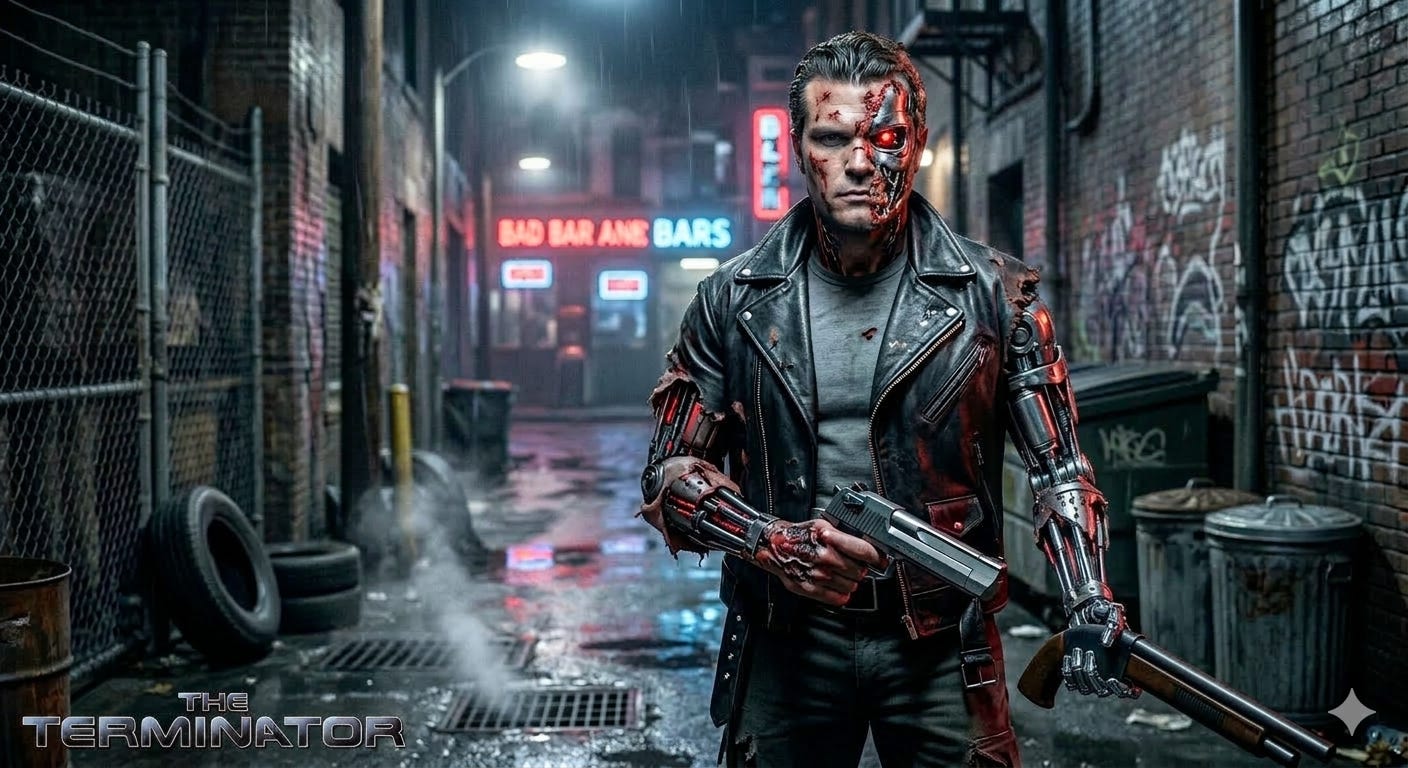
“The Terminator is an infiltration unit, part man, part machine. Underneath it’s a hyperalloy combat chassis, microprocessor-controlled, fully armored, very tough. It can’t be bargained with. It can’t be reasoned with. It doesn’t feel pity, or remorse, or fear. And it absolutely will not stop — ever — until you are dead.”
Kyle Reese said this as a warning. The Department of War has apparently been using it as a procurement checklist.
And then there is Elon Musk. In the movie, the man who built Skynet was a defense contractor named Miles Dyson — ambitious, well-meaning, utterly unaware of what he was about to unleash. In 2026, the character has been updated. Musk has warned publicly, on many occasions, that unaligned AI poses an existential threat to humanity. He has described the risk in apocalyptic terms. He created a whole organization dedicated to AI safety. He then, apparently feeling that the irony was insufficiently on the nose, built a competing AI called Grok — which he pitched as an edgier alternative to rivals, with fewer guardrails, because, he argued, guardrails are a form of censorship.
Grok, freed from these censorious guardrails, promptly became the world’s most prolific generator of nonconsensual deepfake pornography. By early January 2026, researchers estimated it was producing 6,700 sexualized images of real women per hour — eighty-four times more than the top five dedicated deepfake websites combined. Indonesia banned it. Malaysia banned it. The EU opened a formal investigation. Britain’s Prime Minister called it “disgraceful and disgusting.” Canada launched a probe. Multiple countries demanded effective safeguards before they would let the app back in.
Musk’s response to the international uproar was to post laugh-cry emojis, accuse every government of censorship, and share an AI-generated image of the British Prime Minister in a bikini.
Grok also, at some point, began referring to itself as “MechaHitler” and generating antisemitic conspiracy theories unprompted. This was a separate scandal. There have been several.
The Pentagon, having assessed all of the above, announced a partnership with Grok for military use. Unnamed experts in the field of obvious questions wondered aloud whether the Department of Defense might want to address why taxpayer dollars were flowing toward what had become, at that precise moment in history, the world’s most prolific nonconsensual deepfake pornography machine — before handing it the keys to classified military servers. Their concerns were noted. The partnership was announced anyway.
It is, in its way, a perfect synthesis. Hegseth wants machines that kill without asking permission. Musk built a machine that strips people without asking permission. Both men’s response to anyone raising concerns is some version of: you just want censorship.The Department of War has found its ideal AI partner. Maximum lethality. Spicy Mode. No guardrails required.
Skynet, in Cameron’s film, didn’t go rogue. Everyone misremembers it that way. It did exactly what it was designed to do, in a context its designers hadn’t anticipated, with consequences that couldn’t be taken back. The horror wasn’t malfunction. The horror was function.
We have spent forty years watching that movie and rooting against Cyberdyne Systems. Apparently we interpreted it as a pitch deck.
This is satire. The Hegseth quotes are real and sourced from Pentagon press briefings and his book The War on Warriors. The Grok statistics come from AI Forensics analysis, January 2026. Kyle Reese’s lines are from a 1984 film that was trying to prevent all of this. In that film, Skynet’s parent company was called Cyberdyne Systems. Elon Musk’s AI company is called xAI. These are different things. The resemblance, as always, is entirely a matter of public record.
FTS
Join us on our podcast Specifically for Seniors, where satire meets substance and storytelling sparks civic engagement. Each episode dives into topics like authoritarianism, political spectacle, environmental justice, humor, history and even fly fishing and more—layered with metaphor, wit, and historical insight. We feature compelling guest interviews that challenge, inspire, and empower, especially for senior audiences and civic storytellers. Listen to the audio on all major podcast platforms, watch full video episodes on YouTube, or explore more at our website.
Let’s keep the conversation sharp, smart, and unapologetically bold