Springtime for Chaos
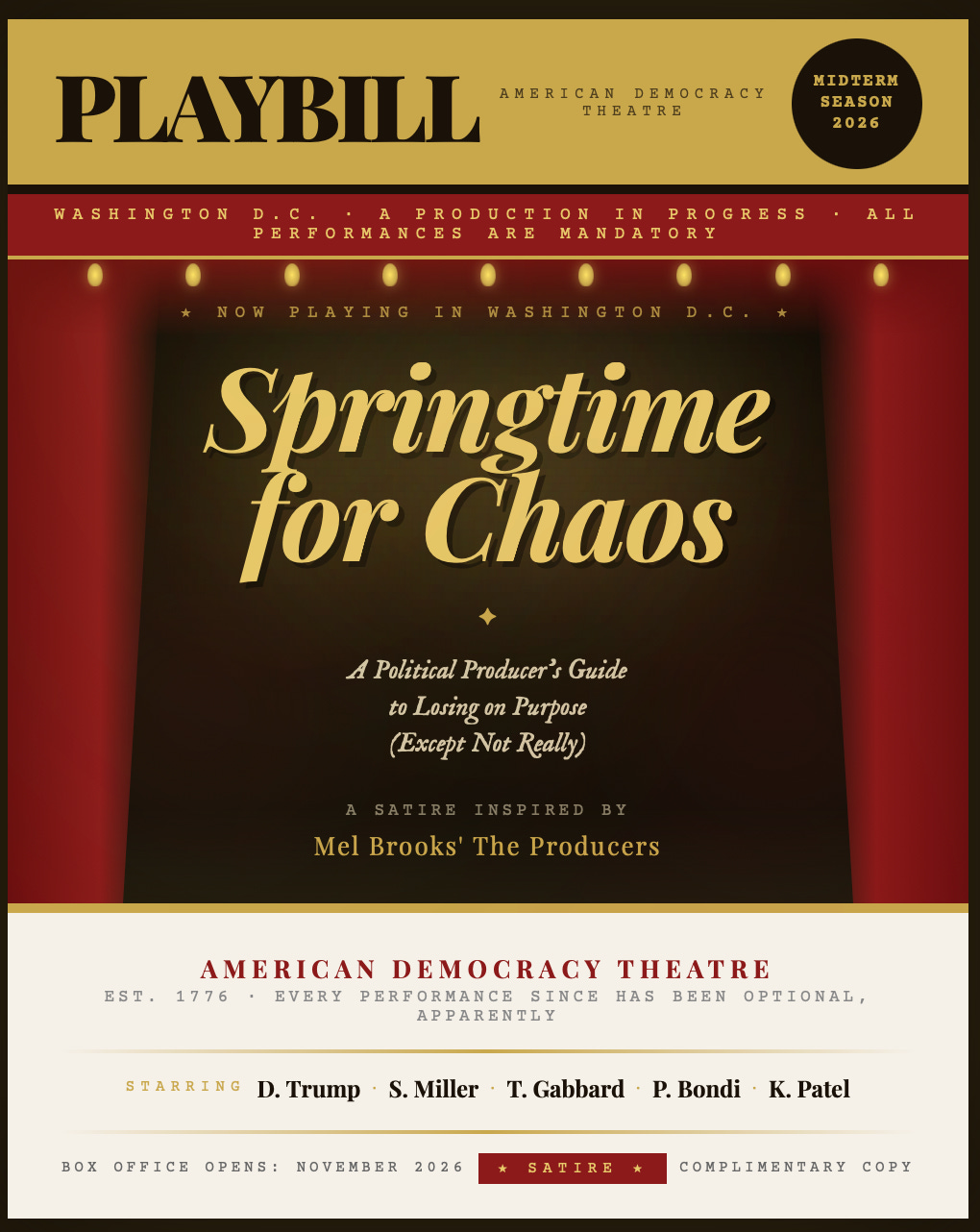
Trump’s Push for Election Power Raises Fears He Will ‘Subvert’ Midterms
The president appears to be undermining Americans’ faith in the outcome, at a moment when Republicans face an uphill climb to keep control of Congress…
Ahead of the midterm elections, an emboldened President Trump has shown an increased eagerness to leverage the full investigative, prosecutorial and legislative powers of the federal government to bend election mechanics to his will…
As the political environment darkens for his party, Mr. Trump is again warning Republicans that Democrats are going to rig the results. At the same time, he is taking actions that make Democrats fear that Republicans are actually going to subvert the election.
New York Times February 25, 2026
1,050 words 4–5 minute read
In Mel Brooks’ 1967 masterpiece The Producers, the scheme was elegant in its simplicity: produce the most catastrophic Broadway flop in history, pocket the oversubscribed investment money, and vanish to Rio. The plan was foolproof. The plan was doomed. The plan accidentally became a smash hit. Sound familiar?
Because if you’ve been watching the Trump administration’s approach to the 2026 midterm elections, you’ve been watching the exact same production — just with worse costumes, a bigger budget, and a cast that somehow keeps getting more powerful with each act.
The parallels aren’t just metaphorical. They are structural. Operational. They follow the same three-act arc that Brooks mapped out 25 years ago, right down to the part where the whole mad scheme spirals beyond anyone’s control — including its architects.
“The biggest mistake Bialystock made was forgetting that the audience gets a vote.”
Max Bialystock didn’t just want to make a bad show. He needed a show so catastrophically bad that no one would question the accounting when it closed after one night. The audacity was the whole point. Pick a script so outrageous — Springtime for Hitler, anyone? — that failure becomes mathematically inevitable.
In the political version, the script is called “pre-emptive fraud claims.” The logic is identical: announce loudly and repeatedly that the election will be rigged, before a single vote is cast. This serves the same function as Bialystock’s casting choices. It’s not incompetence. It’s architecture. Any result becomes useful. A win? You overcame the fraud. A loss? Told you so. You’ve sold 25,000% of the same outcome to every possible investor simultaneously.
The Trump team began its Springtime for Chaos run on this premise well before November, raising questions about election integrity, mail-in ballots, voting machine reliability, and the trustworthiness of local officials in key districts. Not with evidence — evidence would require a closing night. Just with volume. Just with repetition. Just with the sheer accumulating weight of doubt.
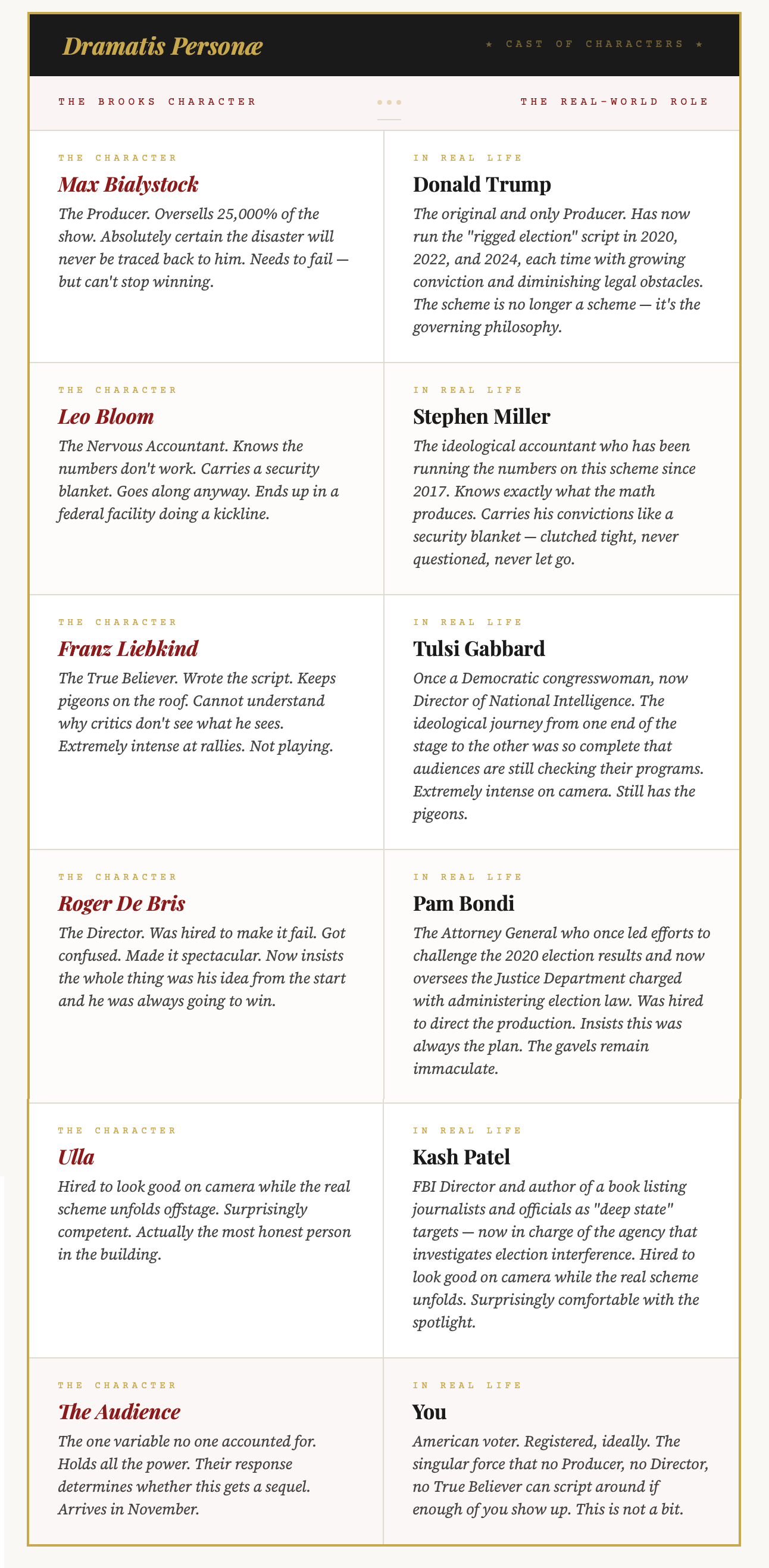
No one understood Bialystock’s genius casting choices until too late. Franz Liebkind, the unhinged true believer. Roger De Bris, the director who couldn’t direct. Leo Bloom, the nervous accountant who knew the numbers didn’t work and went along anyway.
Every great scheme needs its ensemble. Here’s ours.
Here is where the analogy stops being funny.
In Brooks’ film, the disaster becomes a hit by accident — the audience loves Springtime for Hitler as camp, as absurdity, as a joke so outrageous it loops back around to brilliance. Bialystock and Bloom end up in prison. The curtain falls. There’s a closing night. Justice, of a theatrical kind, is rendered.
But manufactured doubt about elections has proven different. It doesn’t close. It compounds. What began in 2020 as a post-hoc rationalization for a lost election has metastasized into a governing doctrine, a litmus test for political loyalty, and — most critically — a pre-loaded narrative for 2026 that is being assembled and positioned before a single vote is cast.
The scheme worked so well it became the product. That’s not a comedy. That’s a different kind of show entirely
★ A CRITICAL NOTE FROM THE STAGE MANAGER ★
Bialystock and Bloom ended up in federal prison, doing a kickline with fellow inmates while singing “Prisoners of Love.” Brooks gave us the closed loop — the scheme had an ending. Democracy doesn’t have a guaranteed third act. There’s no bankruptcy court for institutions. No closing notice posted on the door. The play runs as long as the audience lets it.
The most important line in The Producers isn’t a punchline. It’s the accounting logic that sets everything in motion: if a show is a flop, no one looks at the books. The whole scheme depends on everyone looking away. On the audience not showing up. On the critics losing interest. On the inevitable failure making scrutiny irrelevant.
The parallel holds with eerie precision. Voter suppression, election subversion, pre-emptive delegitimization — these strategies depend, fundamentally, on low turnout. On disengagement. On the audience deciding the show isn’t worth attending.
When the house is full, the books get audited. When everyone shows up, the numbers have to work. Max Bialystock’s nightmare — and the nightmare of any political producer running the same con — is a sold-out house that refuses to leave.
The box office opens in November.
Don’t let someone else buy your ticket.
FTS
Join us on our podcast Specifically for Seniors, where satire meets substance and storytelling sparks civic engagement. Each episode dives into topics like authoritarianism, political spectacle, environmental justice, humor, history and even fly fishing and more—layered with metaphor, wit, and historical insight. We feature compelling guest interviews that challenge, inspire, and empower, especially for senior audiences and civic storytellers. Listen to the audio on all major podcast platforms, watch full video episodes on YouTube, or explore more at our website.
Let’s keep the conversation sharp, smart, and unapologetically bold