The American Cult
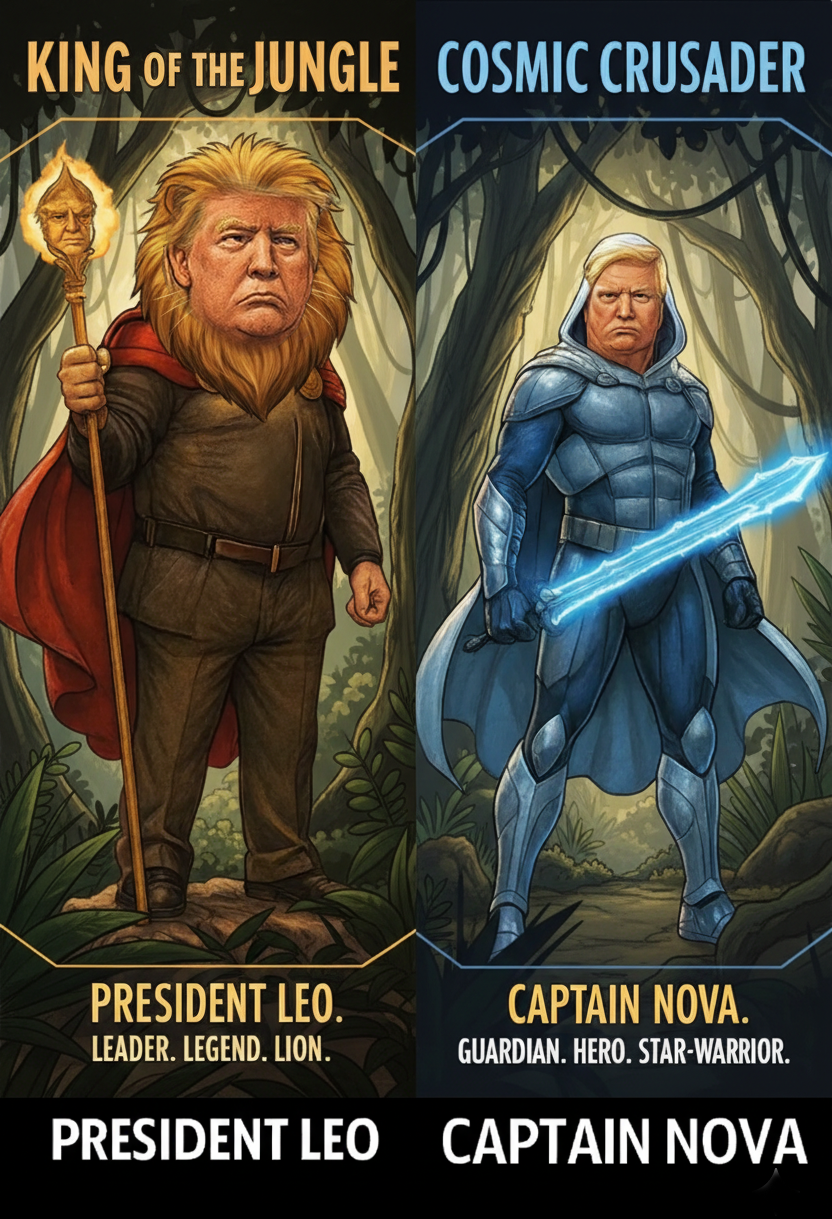
Trump’s Relentless Self-Promotion Fosters an American Cult of Personality
…Mr. Trump has spent a lifetime promoting his personal brand, slapping his name on hotels, casinos, airplanes, even steaks, neckties and bottled water, what he is doing in his second term as president comes closer to building a cult of personality the likes of which has never been seen in American history.
New York Times February 15, 2026
Word Count: 1343 Reading Time: About 5 minutes
The New York Times reported this week that President Trump has been depicting himself as “King of the Jungle,” a Superman, a Jedi knight, a military hero, even as a pope. According to the article, what Trump is doing in his second term “comes closer to building a cult of personality the likes of which has never been seen in American history.”
This is a bold claim—and a terrifying one. But is it true? And if it is, what does history tell us about where this path leads?
The Anatomy of a Personality Cult
A cult of personality isn’t simply popularity or strong support. It’s a deliberately constructed system designed to elevate a single leader above criticism, above institutions, and ultimately above reality itself. As political scientists have documented, these cults share common features: the leader is portrayed as superhuman, infallible, and uniquely capable of saving the nation. Propaganda saturates public life. History is rewritten to center the leader’s achievements. Dissent becomes treasonous.
The twentieth century gave us the most notorious examples: Stalin, Hitler, Mussolini, and Mao. Each built their power on a foundation of carefully crafted self-mythologization.
Stalin’s cult reached absurd heights, with the Soviet leader presented in art as almost Christ-like, complete with halos. His 70th birthday in 1949 was celebrated across the USSR with renamed cities, statues, and fawning tributes. Bulgarian city Varna became “Stalin,” mountains were renamed in his honor across Eastern Europe. Every success was attributed to his genius; every failure blamed on saboteurs and enemies.
Mao Zedong studied Stalin’s playbook carefully. During the Cultural Revolution, his image was literally inserted into the center of the sun in propaganda posters. The Little Red Book became scripture. Speaking with Edgar Snow in 1970, Mao cynically admitted that personality cults were necessary to “stimulate the masses”—to overcome what he called China’s “3,000 years of emperor-worshipping tradition.”
Hitler and Mussolini pioneered similar techniques in Europe. Il Duce saw himself as a new Augustus Caesar. The Führer claimed divine providence and positioned himself as Germany’s savior. Both used emerging mass media—radio, film, carefully staged rallies—to project an image of invincibility.
Trump’s Playbook: An American Adaptation
What makes Trump’s personality cult distinctive is its peculiarly American flavor. Unlike Stalin or Mao, he doesn’t control state media or command a totalitarian apparatus. Instead, he’s exploited democratic institutions, social media, and reality TV culture to achieve similar ends through different means.
The patterns are unmistakable:
Superhuman imagery: Trump regularly shares images of himself as Superman, a king, a biblical figure. After the July 2024 assassination attempt, he claimed a “God-given” mandate. These aren’t jokes—they’re building blocks of a personality cult.
The mission: “Make America Great Again” functions like Stalin’s “building socialism” or Mao’s “Great Leap Forward”—a radical mission that only the leader can accomplish.
Demonization of enemies: The “fake news” media, the “deep state,” political opponents depicted as existential threats. This Manichean worldview—us versus them, good versus evil—is textbook authoritarian behavior.
Transgression as authenticity: Like historical autocrats, Trump’s complete disregard for norms becomes a source of appeal. His supporters see rule-breaking not as disqualifying but as proof of authenticity.
Cult-like loyalty: Research published in Political Psychology found that Trump’s most loyal supporters score unusually high in traits that make them susceptible to “personalistic, loyalty-demanding leaders.” Some evangelical supporters have literally cast him in messianic terms, calling him the “chosen one.”
As one 2016 super PAC communications director put it: “Like Hercules, Donald Trump is a work of fiction.” The difference is that this fiction has convinced millions it’s reality.
The Fatal Pattern: How These Stories End
Here’s what history teaches us: personality cults don’t end well—for the leader, for their followers, or for their nations.
The human cost is staggering. Stalin’s regime killed an estimated 6-40 million through purges, forced labor camps, and engineered famines. Mao’s Great Leap Forward alone caused the deaths of 30-45 million people through starvation. Hitler’s death toll, including the Holocaust and World War II, exceeded 11-12 million civilians plus tens of millions more in combat. These weren’t accidents—they were consequences of unchecked power married to grandiose delusions.
The leaders themselves met varied fates:
Hitler died by suicide in his bunker as Soviet forces closed in on Berlin, his body burned to prevent it from becoming a shrine (April 30, 1945).
Mussolini was captured by communist partisans while trying to flee to Spain, executed by firing squad with his mistress, and their bodies hung upside-down in Milan’s Piazzale Loreto where they were pelted with rocks and spit on by crowds (April 28, 1945).
Stalin died of a stroke at age 74 (March 5, 1953), though his cult was denounced three years later by his successor Khrushchev in the famous “Secret Speech” that exposed his crimes and began de-Stalinization.
Mao died of natural causes at 82 (September 9, 1976), likely from Lou Gehrig’s disease. Yet his legacy of mass death and economic devastation was so profound that China embraced capitalism after his death, effectively repudiating his entire economic vision.
The pattern is clear: whether they died violently or peacefully, their cults eventually collapsed under the weight of their own contradictions. Some fell quickly; others took decades. But all left behind wreckage—shattered economies, traumatized populations, millions dead.
The American Exception?
American exceptionalists will argue that it can’t happen here—that our institutions are too strong, our democracy too resilient. But research suggests that personality cults thrive precisely by eroding institutions from within.
As scholars note, by compelling everyone to publicly acclaim the leader, dictators turn everyone into liars. When everyone lies, no one knows who to trust. This makes organizing opposition nearly impossible. Meanwhile, the leader becomes surrounded by sycophants, loses touch with reality, and makes increasingly catastrophic decisions.
Sound familiar?
The question isn’t whether American democracy is immune to personality cults. The question is how far down this road we’re willing to go before turning back.
Lessons from History
What can we learn from these cautionary tales?
First, personality cults don’t emerge overnight. They’re built methodically, image by image, transgression by transgression, normalized step by normalized step. Today’s absurdity becomes tomorrow’s baseline.
Second, the cult’s power lies not in forcing belief but in manufacturing complicity. When people defend the indefensible, when they accept obvious lies, when they attack truth-tellers—they become invested in the fiction.
Third, institutions don’t automatically protect us. They can be captured, weaponized, or simply abandoned by people who convince themselves the leader is more important than the system.
Fourth, by the time the cult is obvious to everyone, it’s often too late. The guardrails are already gone.
Finally, history’s autocrats believed they were invincible—right up until they weren’t. But the damage they caused outlasted their reigns by generations.
The Choice Ahead
Trump’s self-aggrandizement has indeed reached levels unprecedented in American history. The Times is right about that. Whether it becomes “the likes of which has never been seen” depends not just on Trump, but on the rest of us.
The autocrats of the twentieth century succeeded because enough people chose comfort over truth, tribal loyalty over democratic principle, and the fiction of a strongman over the messy reality of self-governance.
We know how those stories ended. The bodies were counted. The cities renamed. The cults eventually exposed as the lethal fantasies they always were.
The question is whether we’ll learn from history or insist on repeating it.
Because one thing is certain: when historians look back on this moment, they won’t judge us on what Trump did. They’ll judge us on what we allowed.
---
Sources and Further Reading:
• The New York Times, “Trump’s Relentless Self-Promotion Fosters an American Cult of Personality” (February 15, 2026)
• Plamper, Jan. The Personality Cult of Stalin in Soviet Posters, 1929–1953
• Dikötter, Frank. How to be a Dictator: The Cult of Personality in the Twentieth Century
• Johnson, Ian. “Who Killed More: Hitler, Stalin, or Mao?” The New York Review of Books
• Goldsmith et al. “The personality of a personality cult? Personality characteristics of Donald Trump’s most loyal supporters,” Political Psychology (2025)
FTS
Join us on our podcast Specifically for Seniors, where satire meets substance and storytelling sparks civic engagement. Each episode dives into topics like authoritarianism, political spectacle, environmental justice, humor, history and even fly fishing and more—layered with metaphor, wit, and historical insight. We feature compelling guest interviews that challenge, inspire, and empower, especially for senior audiences and civic storytellers. Listen to the audio on all major podcast platforms, watch full video episodes on YouTube, or explore more at our website.
Let’s keep the conversation sharp, smart, and unapologetically bold