The Autograph That Ate Itself
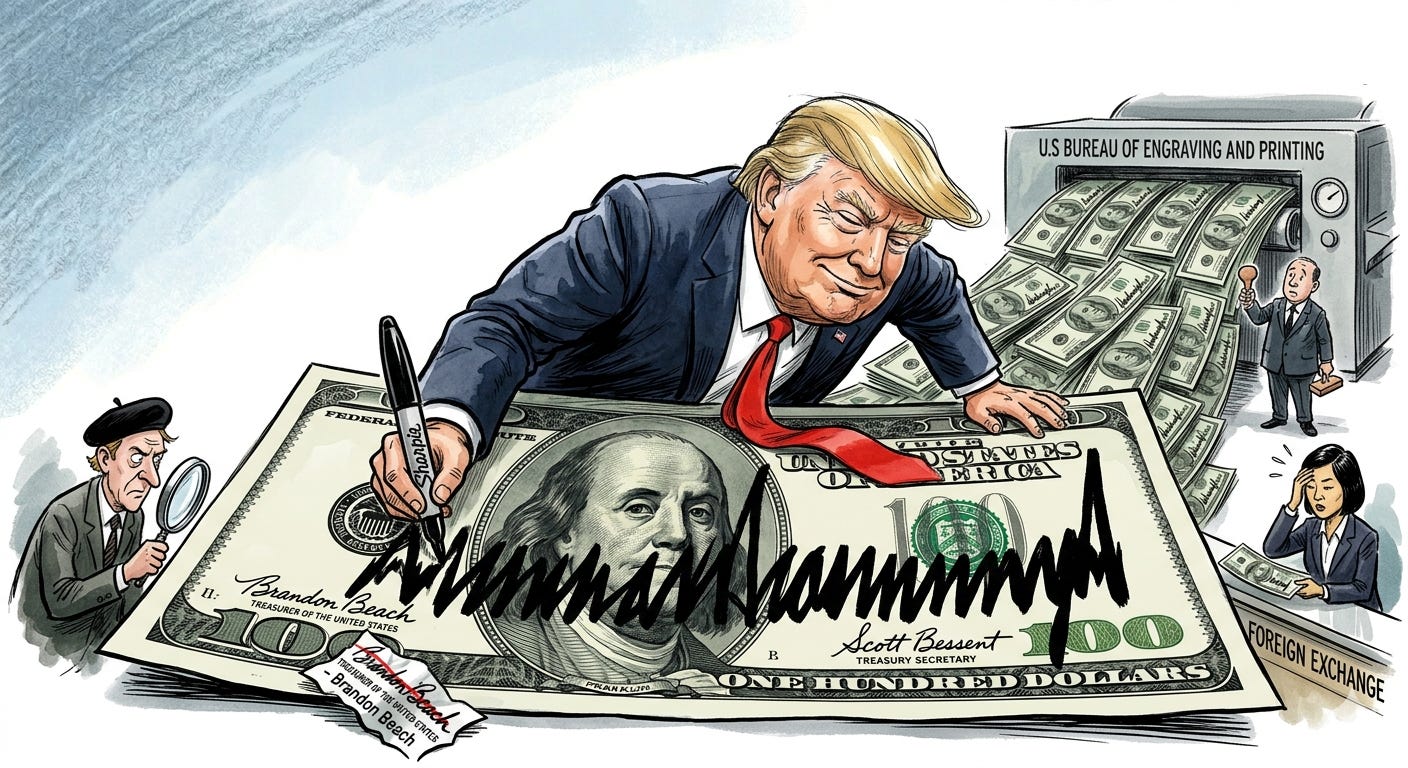
Trump’s Signature Is Set to Be Added to America’s Currency
“There is no more powerful way to recognize the historic achievements of our great country and President Donald J. Trump than U.S. dollar bills bearing his name, and it is only appropriate that this historic currency be issued at the semiquincentennial,” Mr. Bessent said in a statement.
The addition of Mr. Trump’s signature to dollars is the latest example of the president emblazoning national institutions with his personal brand as he looks to permanently imprint his legacy in American society.
New York Times March 27, 2026
Word Count: 840 Reading time: 4 minutes
There is a certain kind of man who signs everything. His name on the lease, his name on the tower, his name on the steak, the university, the water bottle, the Bible. For this kind of man, the signature is not a legal instrument — it is a territorial marking. A dog whistle in Sharpie. It says: I was here. This is mine. Remember me.
Donald Trump is that kind of man. And now, he has signed your money.
Not because the law requires it. Not because any president before him — not Lincoln, not FDR, not Reagan — thought it appropriate. But because he wanted to. And because nobody with the spine to stop him is left in the building.
What Actually Happened — And Who Got Erased
Let’s be precise, because the details are devastating.
Starting this summer, Trump’s signature will appear on U.S. paper currency for the first time in history — replacing the signature of the U.S. Treasurer, who oversees the Bureau of Engraving and Printing, and appearing alongside that of Treasury Secretary Scott Bessent.
The Treasurer being displaced is Brandon Beach — a Georgia state senator Trump himself appointed just last year. In doing so, Trump had already broken a 76-year streak of women holding the position. Having installed his loyalist, he has now erased him from the currency entirely. Beach, it turns out, was useful right up until his signature stood between Trump and a photo opportunity.
Here is what makes this legally obscene: by law, both the Treasurer and the Treasury Secretary must sign Federal Reserve notes before they can become legal tender. Brandon Beach’s signature isn’t decorative. It is one of exactly two signatures with any legal standing on the face of American currency. Trump’s signature has none. Zero. It carries no more legal authority than a personalized inscription in a copy of The Art of the Deal.
The man with the legally required signature got bumped. The man with the legally meaningless signature moved to the front of the line. If you’re looking for a metaphor for the last four years, you just found it printed on a hundred dollar bill.
The Most Legally Precise Burn in American History
Trump’s signature on the U.S. dollar is, in the strictest legal sense, identical in authority to his signature on a McDonald’s napkin.
Not figuratively. Literally. Under 31 U.S.C. § 5103, a bill’s status as legal tender flows entirely from its issuance by the Federal Reserve — not from whose name is printed on the face. The two signatures that actually make a dollar a dollar remain: Treasury Secretary Scott Bessent’s, which is legally required, and now Trump’s, which is not.
The napkin comparison, it turns out, undersells the napkin. A McDonald’s napkin bearing Trump’s signature has sold at auction for $900. A Trump-signed dollar bill, once his signature appears on the hundreds of billions of notes currently in circulation, will be worth exactly one dollar. Possibly less, if you’re trying to spend it in Paris.
The Collector’s Market Paradox: How to Destroy Your Own Brand in One Executive Order
Here is the thing about signed Trump memorabilia: it has always traded on scarcity. A signed MAGA hat — $400. A signed copy of The Art of the Deal — $600. A signed photograph — anywhere from $250 to $2,000, depending on the venue and the desperation of the buyer.
Trump has spent forty years meticulously, obsessively, almost artistically cultivating the commercial value of his autograph. It is, in a very real sense, one of his core business assets.
And now, with a single directive to his Treasury Secretary, he has flooded the market.
Four billion Federal Reserve notes are printed every year. There are currently around 50 billion individual bills in worldwide circulation. By the time the new series rolls out across all denominations, Donald Trump’s signature will be the single most reproduced autograph in the history of human civilization — more ubiquitous than a terms-of-service agreement, more common than regret.
He is the only man in recorded history to devalue his own signature by putting it on money. This is, economists will note, the opposite of how money is supposed to work. He came to glorify the dollar and ended up cheapening himself.
The International Problem: The World Didn’t Sign Off On This
Here is what the White House press release quietly omitted: the rest of the world is not obligated to care.
The legal tender statute — “valid for all debts, public charges, taxes and dues” — is American domestic law. Its jurisdiction ends at the border. Foreign governments, businesses, and individuals accept U.S. dollars for one reason only: institutional trust. The credibility of American governance. The stability of its currency. The reliability of its institutions.
None of those things are enhanced by a president printing his name on the money.
Any foreign country, any business, any individual trading partner can tomorrow announce they will not accept bills bearing Trump’s signature — and they would be on perfectly solid legal ground. There is no treaty, no IMF rule, no international law that compels acceptance of any specific version of U.S. currency. The dollar’s reserve currency status is not a legal mandate. It is a collective act of faith, renewed daily, that America’s institutions are bigger than any one person who passes through them.
The signature says otherwise. It says the money belongs to him. And the rest of the world — particularly those already nursing fresh tariff wounds — is perfectly entitled to take him at his word and decline the transaction.
The dollar’s global dominance has survived wars, recessions, and the 2008 financial crisis. Whether it can survive being turned into a vanity project is a question no Treasury Secretary should ever have had to consider.
The Punchline
Strip away the pageantry and what remains is this: a man printed his name on the public’s money because he could, not because the law required it, not because any predecessor thought it appropriate, and not because it adds a single cent to the dollar’s value or credibility.
He displaced a legally required officer to do it. He turned currency into merchandise. He simultaneously made his signature the most common autograph on earth and rendered it legally meaningless — the rarest and most expensive thing about a Trump signature has always been its scarcity, and he just gave one to every American whether they wanted it or not.
The autograph that was supposed to mean everything turns out to mean nothing.
Which, if you’ve been paying attention, is the most on-brand outcome imaginable.
Forward this to your wallet. It’ll be carrying his signature by summer whether you like it or not.
FTS
Join us on our podcast Specifically for Seniors, where satire meets substance and storytelling sparks civic engagement. Each episode dives into topics like authoritarianism, political spectacle, environmental justice, humor, history and even fly fishing and more—layered with metaphor, wit, and historical insight. We feature compelling guest interviews that challenge, inspire, and empower, especially for senior audiences and civic storytellers. Listen to the audio on all major podcast platforms, watch full video episodes on YouTube, or explore more at our website.
Let’s keep the conversation sharp, smart, and unapologetically bold