The Chairman of Peace and the Coming War
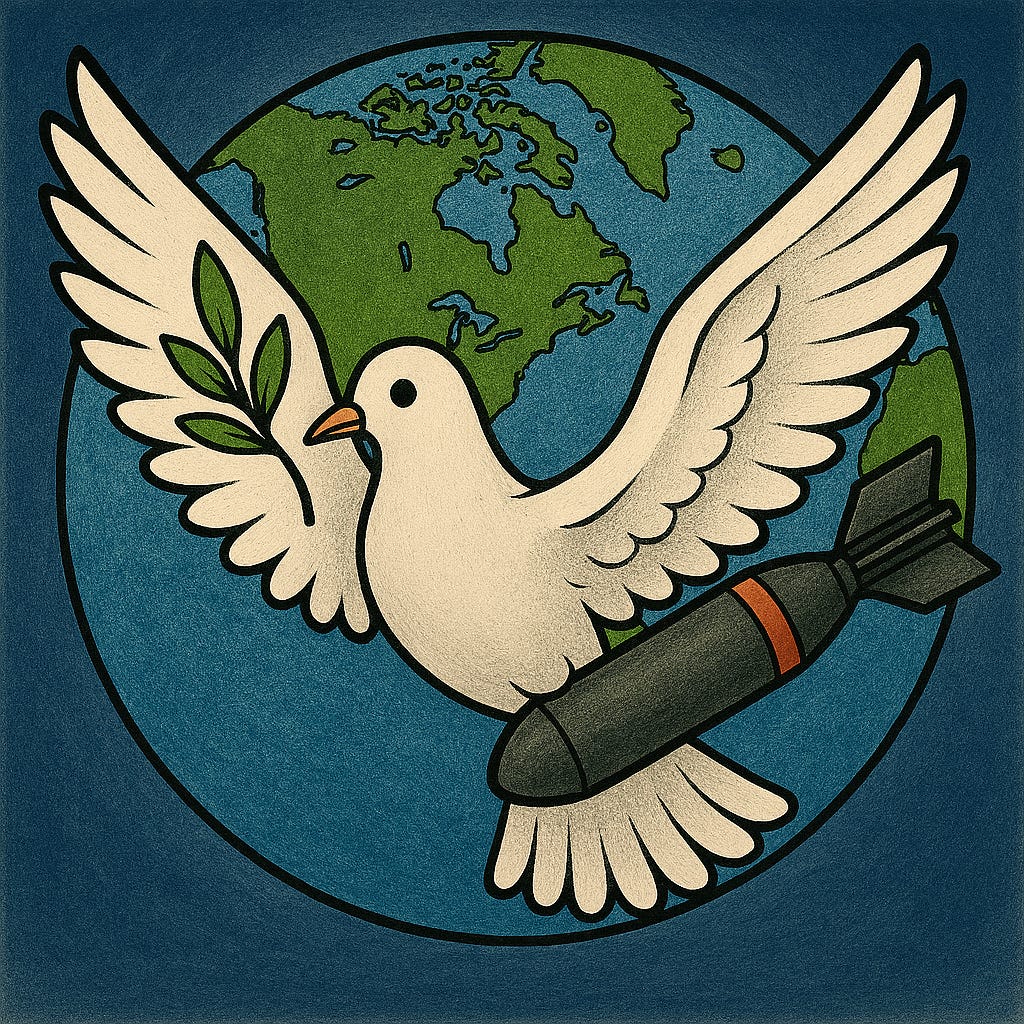
This Is How an Autocrat Goes to War
On Wednesday, Axios’s well-sourced reporter Barak Ravid warned, “The Trump administration is closer to a major war in the Middle East than most Americans realize. It could begin very soon.” America has undertaken the largest air power buildup in the region since the Iraq war. Outlets including The New York Times have reported that the military has given Trump the option to strike as soon as this weekend.
New York Times Opinion Feb. 20, 2026
and
The Board of Peace
Today, President Trump greets his creation. The Board of Peace will hold its first gathering since more than 20 nations signed the board’s founding charter last month. Delegates will talk about how to rebuild Gaza.
But the board, a kind of Trump-aligned alternative to the United Nations, is aiming much higher. It wants to “secure enduring peace in areas affected or threatened by conflict,” according to the charter.
New York Times February 19, 2026
Word Count: ~1000 Reading Time: 5 min
On February 19, Donald Trump stood before representatives of more than 40 nations at the U.S. Institute of Peace — a building that now bears his name — and declared himself the architect of a new world order. He called his creation the Board of Peace. He pledged $10 billion in American funds to rebuild Gaza. He summoned heads of state, extracted financial commitments, and basked in the spectacle of global leaders gathered beneath his personal banner. The price of admission? Nations that want a permanent seat must pay $1 billion in cash within the first year — in full, up front, to a fund controlled by Trump. Those unwilling or unable to pay get a three-year term, renewable at the chairman’s discretion. The chairman, of course, serves for free. For life. He called the whole arrangement, with characteristic humility, “the most prestigious Board of Leaders ever assembled, at any time.”
Less than 24 hours later, the New York Times ran a piece headlined: This Is How an Autocrat Goes to War. The subject was Iran. And the man threatening war was the same one who had just finished hosting the peace summit.
The contradiction would be stunning if it weren’t so perfectly on-brand. At the Board of Peace meeting itself — not the next day, not in a separate press conference — Trump gave Iran a 10-day countdown to choose between diplomacy and a military strike. “We may have to take it a step further, or we may not,” he told the assembled dignitaries. The peace summit and the war ultimatum were not separate events. They shared a podium.
By that evening, multiple outlets reported that the U.S. military was positioned for a massive, weeks-long campaign against Iran — the largest air power buildup in the Middle East since the Iraq War. Congress had not authorized it. Congress had barely discussed it. No administration official had explained to the American people what the objective would be, what success looks like, or what comes after.
“Trump isn’t trying to persuade the country that war is in their interests. All that matters is whether he thinks it’s in his.”— New York Times Opinion, February 20, 2026
There is also the small matter of logic. Trump spent months claiming that last year’s bombing campaign obliterated Iran’s nuclear program. The White House website still carries that declaration — Iran’s facilities “obliterated,” any suggestion otherwise dismissed as “fake news.” And yet here is the administration preparing for war to eliminate a program it insists no longer exists. You cannot simultaneously take a victory lap and use the unfinished threat as a casus belli. Unless the justification was never really the point.
Then there is the money. To sit permanently on Trump’s Board of Peace — to have a guaranteed voice in this new institution that will, in his words, “look over” the United Nations — nations must pay one billion dollars. Not as a contribution to a shared reconstruction fund. As an entry fee. As tribute to the chairman.
And the chairman holds a veto over most of the board’s decisions. The chairman cannot be removed. The chairman retains his position even after leaving the American presidency. In the entire history of postwar international institutions — the UN, NATO, the World Bank, the International Court of Justice — there is no precedent for this structure. Because the entire postwar diplomatic architecture was deliberately designed to prevent exactly this kind of arrangement.
The men and women who built that architecture after 1945 were not idealists. They were realists, shaped by the knowledge of what seventy million dead looked like. They understood that unchecked personal authority in the international arena — one man, one vision, one veto — was not a feature of the prewar order. It was the cause of it. The UN, for all its dysfunction, was built on sovereign equality. Every nation, one voice. The Board of Peace is built on something entirely different: wealth buys your seat, and one man holds the veto for life.
The Board of Peace doesn’t reform the postwar system. It is its philosophical opposite — a return to the great-man structure that the architects of 1945 spent everything trying to prevent.
It is not incidental that the countries refusing to join include France, Germany, the UK, Italy, Sweden, Norway, Spain, Poland, and Ukraine. These are the core nations of the Western alliance that built the postwar world. Their refusal is not a diplomatic snub. It is a verdict.
What we witnessed across these 48 hours deserves to be named clearly. A leader convened a global institution and appointed himself its permanent, unchallengeable head. He demanded that sovereign nations pay a billion dollars each for the privilege of sitting beneath his authority. He positioned this institution as a body that will supervise — and potentially replace — the United Nations. He threatened to launch a major war without congressional authorization, public justification, or democratic deliberation of any kind. And he did all of this on the same day, from the same room, at an event called the Board of Peace.
It would be tempting to chalk this up to the familiar chaos of Trump’s thinking — the impulsiveness, the contradiction, the gold-plated grandiosity. But that reading lets him off the hook. There is a thread running through all of it. Not a strategic vision, but an ego logic. The Board of Peace is not about Gaza. The Iran threat is not about nuclear weapons. Both are about the same thing: the performance of dominance, the accumulation of personal power, and the slow dismantling of every institutional check the postwar world spent eighty years building.
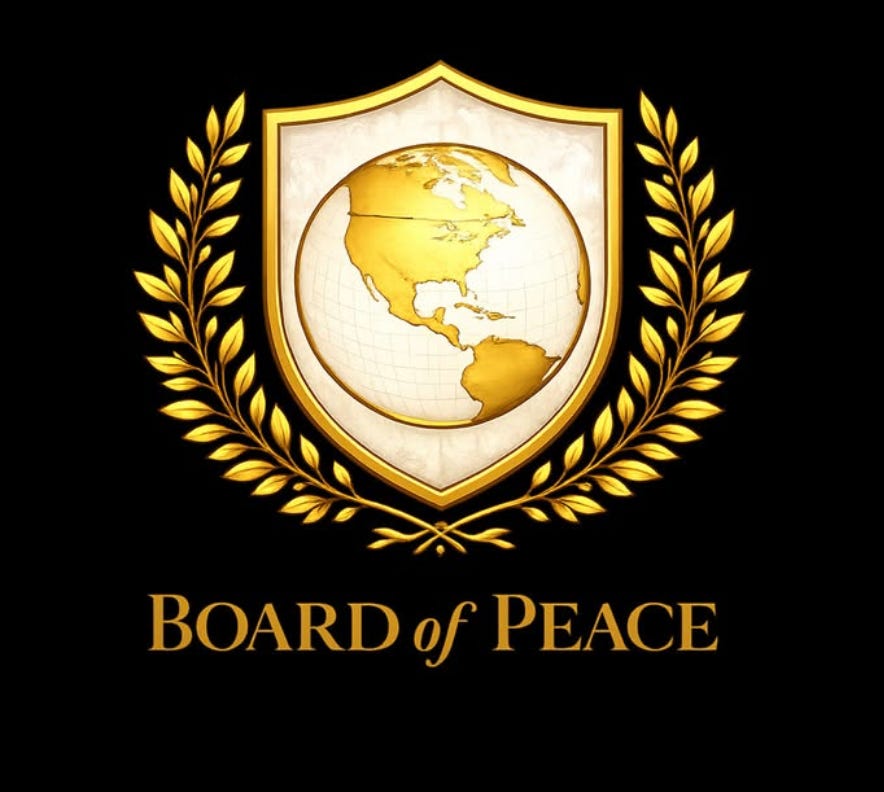
The board’s logo — widely mocked as AI-generated slop, a crude knockoff of the UN emblem burnished in Trumpian gold — turns out to be the most honest symbol of the whole enterprise. A copy of something real, made to look grander than the original, controlled entirely by one man, stamped with his aesthetic from top to bottom.
That is not a peace initiative. That is a portrait of how democracies end — not with a coup, but with a summit, a billion-dollar entry fee, and a lifetime chairmanship announced to applause.
Sources: New York Times Opinion, "This Is How an Autocrat Goes to War," Feb. 20, 2026 · New York Times, "The Board of Peace," Feb. 19, 2026 · ABC News, NPR, Euronews reporting on the Board of Peace inaugural meeting.
FTS
Join us on our podcast Specifically for Seniors, where satire meets substance and storytelling sparks civic engagement. Each episode dives into topics like authoritarianism, political spectacle, environmental justice, humor, history and even fly fishing and more—layered with metaphor, wit, and historical insight. We feature compelling guest interviews that challenge, inspire, and empower, especially for senior audiences and civic storytellers. Listen to the audio on all major podcast platforms, watch full video episodes on YouTube, or explore more at our website.
Let’s keep the conversation sharp, smart, and unapologetically bold