The Imperium Returns
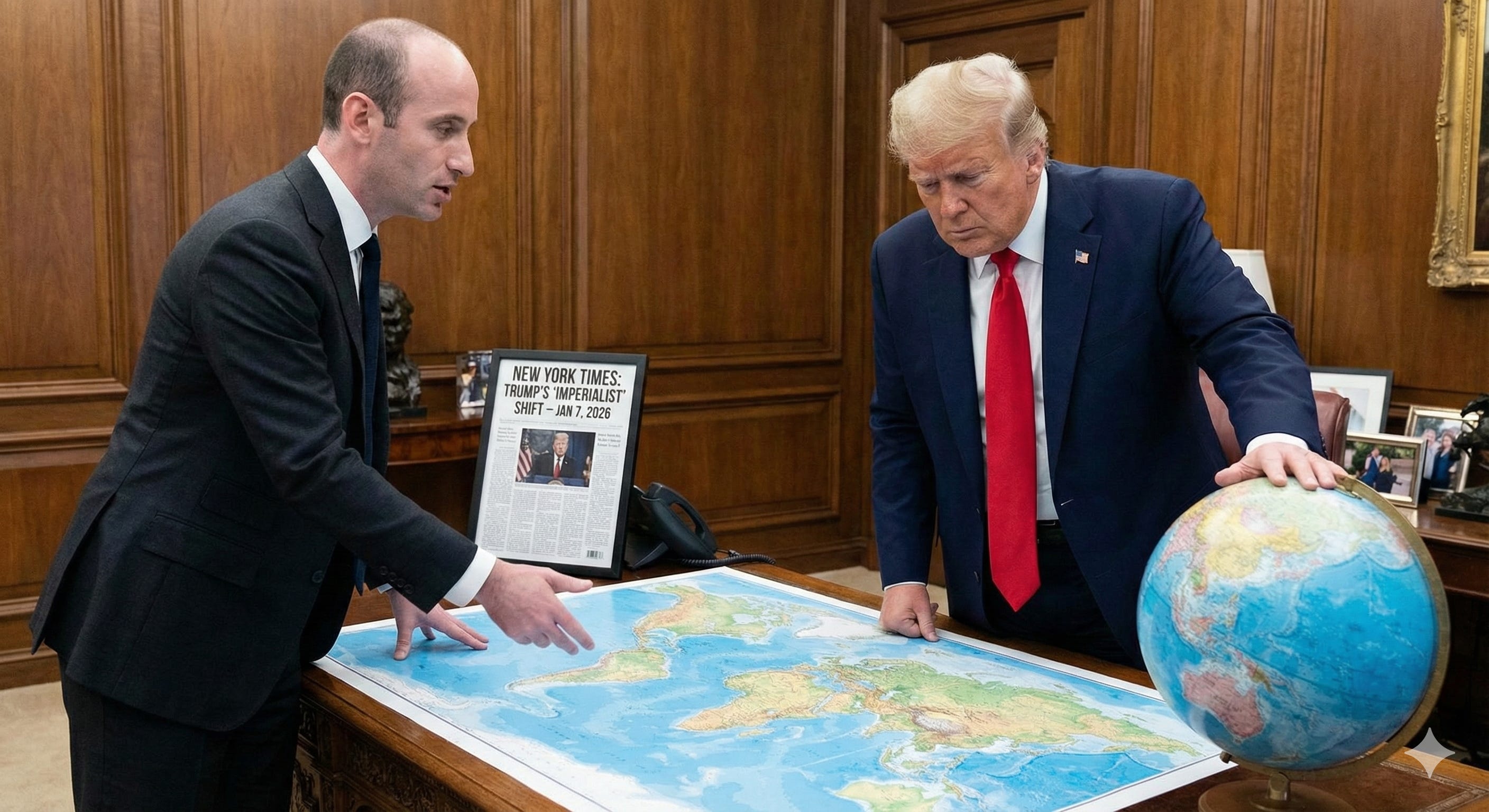
Europe and Rest of World Try to Come to Terms With Trump the Imperialist
Needing U.S. support to fend off Russia in Ukraine, European leaders have been cautious about criticizing President Trump on Greenland, Iran, Venezuela and much else.
New York Times January 7, 2026
AND
Stephen Miller Offers a Strongman’s View of the World
Now, Mr. Miller, President Trump’s 40-year-old deputy chief of staff for policy and homeland security adviser, is casting his hard-right gaze further abroad: toward Venezuela and the Danish territory of Greenland, specifically.
Mr. Miller is doing so, the president’s advisers say, in service of advancing Mr. Trump’s foreign policy ambitions, which so far resemble imperialistic designs to exploit less powerful, resource-rich countries and territories the world over and use those resources for America’s gain. According to Mr. Miller, using brute force is not only on the table but also the Trump administration’s preferred way to conduct itself on the world stage.
New York Times January 6, 2026
The early days of 2026 have brought a chilling clarity to the “Trump Doctrine.” According to a series of bombshell reports from the New York Times, the administration—driven by the “hard-right gaze” of Deputy Chief of Staff Stephen Miller—has pivoted from mere isolationism to what many are calling New Imperialism. The strategy is as ancient as it is jarring: the exploitation of less powerful, resource-rich territories to fuel American dominance. From the push to acquire Greenland to the “strongman” pressure on Venezuela, the world is coming to terms with an America that no longer asks for cooperation but demands resources through “brute force.”
Stephen Miller’s worldview, as articulated in recent briefings, mirrors the 19th-century “Scramble for Africa.”During that era, European powers viewed entire continents not as sovereign nations, but as a map of raw materials—rubber, gold, and oil—to be extracted for the metropole.
In 2026, we see this pattern repeating. The focus on the Danish territory of Greenland and the oil wealth of Venezuela signals a return to Territorial Imperialism. It is a modern iteration of Manifest Destiny, where strategic land is treated as a commodity to be bought or taken. Miller’s preference for “brute force” echoes the Roman Empire’s treatment of “client kingdoms”: provide tribute and resources, or face the legions.
There is a prevailing narrative that European leaders have been “cautious” or cowed into silence, trading their criticisms of Trump for U.S. support against Russia in Ukraine. However, this is a dangerous oversimplification. Europe is not merely silent; it is walking an impossibly thin tightrope.
While European leaders are indeed desperate to maintain the U.S. security shield, they have not been entirely passive:
The Sovereignty Rebuke: When the administration revived talk of Greenland, Danish and Nordic leaders were explicit. Prime Minister Mette Frederiksen’s dismissal of the idea as “absurd” was a clear signal that there are “red lines” regarding territorial integrity that cannot be traded for security.
Strategic Autonomy: Behind the “cautious” public statements, leaders like Emmanuel Macron are using this “imperialist” pivot to argue for European Strategic Autonomy. They are effectively telling their citizens: If our protector becomes a predator, we must be able to stand alone.
The Ukraine Gamble: Europe views Ukraine as an existential survival issue, whereas the 2026 Trump administration appears to view it as a bargaining chip in a “Great Power” deal with Russia. This fundamental misalignment is creating a “Dual Track” diplomacy where Europe publicly aligns with the U.S. while privately building its own defense industry to hedge against an American abandonment.
For the global markets, this shift represents a move toward Hyper-Mercantilism. The administration is attempting to “re-peg” the U.S. Dollar to physical assets—oil and minerals seized or controlled abroad—to replace the eroding “soft power” trust in U.S. debt.
History, however, suggests this is a high-interest loan. Imperial Overreach—the point where the cost of military occupation and “brute force” exceeds the value of the loot—has toppled every empire from Rome to the British Raj. By treating NATO as a “protection racket” and weaponizing the dollar, the U.S. is inadvertently accelerating de-dollarization and pushing allies to seek protection from rivals like China.
History is a harsh teacher for those who attempt to rule through extraction. Whether it was the Delian League of Ancient Greece or the Big Stick diplomacy of the early 20th century, treating allies as “client states” eventually leads to a total fracture of the alliance.
As we look at the headlines of January 2026, the question is no longer whether America has the power to take what it wants. The question is whether it can afford the isolation that follows. Europe isn’t just being “cautious”—it is preparing for a world where the “American Shield” comes with a price tag too high to pay.
FTS
This space isn’t meant to be a monologue. It’s a dialogue — sharp, satirical, and sometimes uncomfortable. Do you agree with the stance? Disagree with the framing? See illusions I’ve missed? Add your voice. Comment, challenge, expand, dismantle. The sharper the exchange, the clearer the vision. Disillusionment isn’t passive; it’s participatory.
Join us on our podcast Specifically for Seniors, where satire meets substance and storytelling sparks civic engagement. Each episode dives into topics like authoritarianism, political spectacle, environmental justice, humor, history and even fly fishing and more—layered with metaphor, wit, and historical insight. We feature compelling guest interviews that challenge, inspire, and empower, especially for senior audiences and civic storytellers. Listen to the audio on all major podcast platforms, watch full video episodes on YouTube, or explore more at our website.
Let’s keep the conversation sharp, smart, and unapologetically bold.