The Man Who Wants to Undo 1776
I See Him as a Pretty Thoroughgoing Illiberal at This Stage
Vice President JD Vance, by far the front-runner in the contest for the 2028 Republican presidential nomination, has become the leading elected official aligned with a movement questioning the founding principles of American democracy….
If Trump were to win in 2024, Vance continued, he should “fire every single midlevel bureaucrat, every civil servant in the administrative state, replace them with our people. And when the courts stop you, stand before the country like Andrew Jackson did, and say: ‘The chief justice has made his ruling. Now let him enforce it.’”
March 3, 2026 New York Times Thomas B. Edsall, Guest Essay
1,260 words · 5 min read
There is a question that serious people are beginning to ask out loud, and it deserves a serious answer: Is JD Vance more dangerous to American democracy than Donald Trump?
At first glance, the question seems almost absurd. Trump is the sitting president. He is the one issuing executive orders, purging the federal workforce, defying congressional oversight, and testing the limits of institutional resistance in real time. How could his vice president — a man whose formal powers are constitutionally minimal — represent a greater long‑term threat?
The answer lies not in what Vance does, but in what he believes. And what he believes should alarm anyone who takes the founding principles of this republic seriously.
Two Very Different Kinds of Dangerous
Thomas Edsall, writing in the New York Times, draws a distinction that cuts to the heart of this question. Trump governs from the gut — reactive, impulsive, driven by ego and the hunger for loyalty. His authoritarian impulses are real, but they are also chaotic. They do not proceed from a coherent theory of government so much as from a bottomless appetite for dominance.
Vance is something else entirely. Unlike Trump, who is in it for the power, Vance is an ideologue. He believes something. And what he believes, when examined carefully, is a systematic rejection of the philosophical tradition that produced the American republic.
That distinction matters enormously. History’s most durable authoritarian transformations have not been accomplished by strongmen alone. They have been accomplished by strongmen backed by intellectuals willing to provide the legal and philosophical architecture for what the strongman wants to do. Trump provides the disruption. Vance and his network are building the blueprint.
The Founding Framework — and Why Vance Rejects It
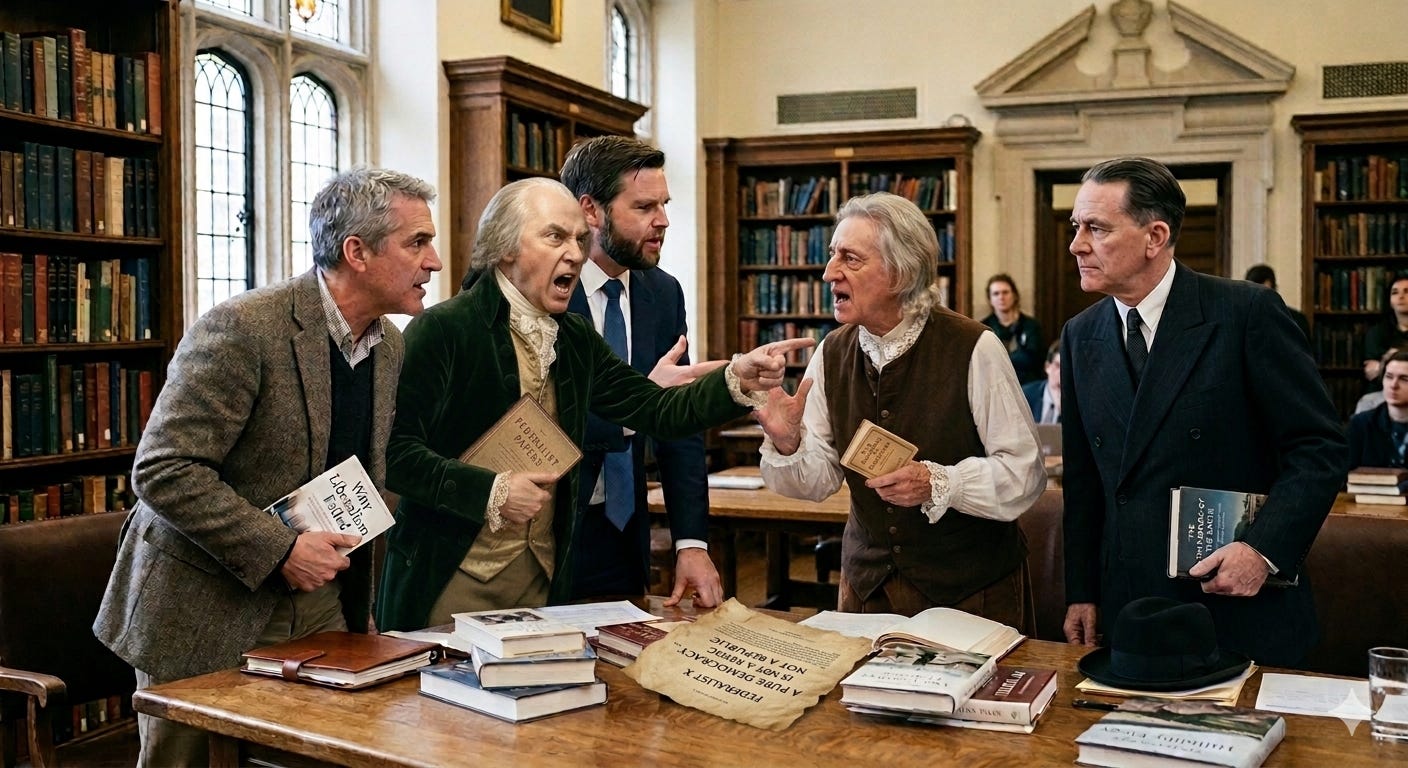
The men who wrote the Declaration of Independence and the Constitution were products of the Enlightenment. They drew from John Locke, Montesquieu, and a tradition of political philosophy that held certain principles to be foundational: that rights belong to individuals by nature, not by government grant; that power derives from the consent of the governed; that no single person or institution should hold unchecked authority; and that a pluralist society — one tolerating different beliefs and ways of life — was both possible and desirable.
These were not incidental decorations on the American founding. They were its philosophical core. The separation of powers, the Bill of Rights, the independent judiciary — all of it flows from Enlightenment liberalism. Madison did not stumble onto checks and balances. He built them deliberately, because he understood that concentrated power, in anyone’s hands, is the eternal enemy of free government.
Patrick Deneen, Vance’s most important intellectual influence, argues that these very principles are the problem. In Why Liberalism Failed and Regime Change, Deneen contends that liberalism’s emphasis on individual autonomy dissolves the bonds of family, community, religion, and tradition that hold societies together. The social decay visible across working‑class America is, in his view, not a deviation from the founding vision but its logical endpoint.
This is a genuinely radical position. Most conservatives — Reagan conservatives, traditional conservatives — argued that America had strayed from its founding principles and needed to return to them. Deneen and Vance argue something categorically different: that the founding principles themselves were the mistake.
Carl Schmitt’s Ghost
Carl Schmitt was a German jurist who joined the Nazi Party in 1933 and provided much of the legal justification for the dismantling of the Weimar Republic. His core contribution to authoritarian theory was the concept of the state of exception — the idea that the true sovereign is whoever gets to declare an emergency, and that during such an emergency, normal legal constraints are suspended.
What is striking is how directly this framework has been absorbed into the intellectual network surrounding Vance. Harvard Law professor Adrian Vermeule — one of Vance’s closest intellectual allies — has drawn extensively on Schmitt’s ideas in his work on administrative law and emergency powers. Curtis Yarvin, another figure Vance has credited with shaping his thinking, has argued for a radically empowered, CEO‑style executive with far fewer constitutional constraints.
Analysts at institutions such as the Independent Institute have documented how this normalization works: first, highlight extreme cases where emergency discretion seems plausible; then argue that executive discretion has grown anyway, so we might as well embrace it. The Weimar parallel is not hyperbole — it is structural. The Weimar Republic had a constitution. It had courts. It had elections. It fell because a legal framework was constructed to route around those institutions.
Madison saw this coming. The entire architecture of the Constitution was designed to prevent any single person from claiming that the crisis was so severe that normal rules must be suspended.
The Deepest Irony
What makes Vance’s project so insidious — and so difficult to confront — is that it wraps an anti‑founding ideology in founding‑era aesthetics. The flags, the constitutional rhetoric, the appeals to the American people — all of it sounds patriotic. It is designed to sound patriotic.
But underneath the pageantry, Vance has embraced an intellectual framework that treats the Constitution’s philosophical foundation as a 250‑year mistake. His vision is not a restoration of the founding but a transformation away from it, toward something that resembles the confessional European states the Founders were explicitly rejecting.
Jefferson’s “wall of separation” between church and state was not a casual metaphor. It was a deliberate architectural choice, born of hard historical knowledge about what happens when state power and religious authority merge.
What Is at Stake
Trump is a disruptor. He damages institutions through neglect, ego, and the daily stress‑testing of norms. That damage is real and serious. But disruption, even severe disruption, can be repaired.
What Vance represents is something harder to repair: a coherent intellectual case for why those institutions and norms should not exist in the first place. He is not weakening the Founders’ framework out of impulsiveness or ignorance. He is doing it with intention, backed by a network of legal theorists and political philosophers who have spent years constructing the argument.
The Founders feared exactly this — not the brute who seizes power, but the sophisticated architect who builds the case for why the seizure is justified, even necessary, even righteous.
They built a republic to resist it.
The question now is whether that republic is strong enough to hold.
FTS
Join us on our podcast Specifically for Seniors, where satire meets substance and storytelling sparks civic engagement. Each episode dives into topics like authoritarianism, political spectacle, environmental justice, humor, history and even fly fishing and more—layered with metaphor, wit, and historical insight. We feature compelling guest interviews that challenge, inspire, and empower, especially for senior audiences and civic storytellers. Listen to the audio on all major podcast platforms, watch full video episodes on YouTube, or explore more at our website.
Let’s keep the conversation sharp, smart, and unapologetically bold