The Peace President's War: A Baseball Cap, a Gala, and a Nation Without a Plan
Word count: 1,247 | Reading time: approximately 5 minutes
Why I’m Writing This
I have grandchildren of draft age.
That sentence used to be abstract — the kind of thing you say to make a political argument feel personal. It isn’t abstract anymore. Not this week.
When a president orders an undeclared war with no strategy, no exit plan, no congressional authorization, and no explanation — and then goes to a fundraising party — those of us watching with grandchildren in mind aren’t asking abstract constitutional questions. We’re asking: who is going to fight this war he just started?
And the answer, as it always is, is: not him. Not his family. Not his donors at Mar-a-Lago. The people who fight it will look like our grandchildren.
I’m also writing this because of everything this war is instead of. Every dollar that flows into an undefined Middle East campaign is a dollar not feeding a hungry child in this country and others. Not fixing a broken healthcare system. Not addressing the climate crisis that will define the world our grandchildren actually inherit. These are not abstractions. These are explicit, deliberate choices — made by a man in a baseball cap who had time for a gala but not for the Situation Room.
Public comments and polling already show what Americans think of this. The people were not consulted. The people do not want this. And in a democracy — if we still mean that word — a president’s actions are supposed to represent what the people want.
So we have to ask the question plainly: Was this war necessary? Not rhetorically. Seriously. Because nobody in power has answered it. And until they do, the rest of us — those of us with something real to lose — are going to keep asking.
The Image That Says Everything
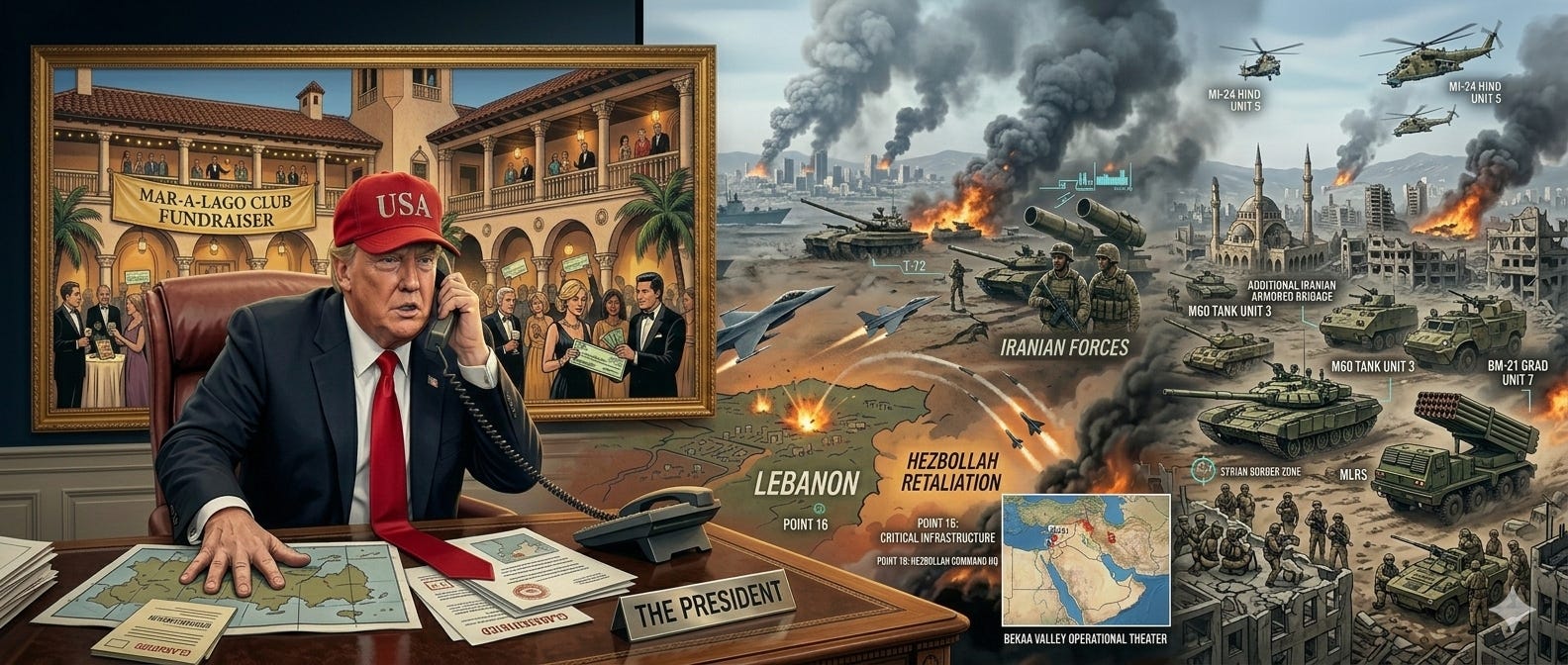
Let’s start with the image, because it tells you everything.
The President of the United States orders military escalation in the Middle East. American forces are deploying. Iran and Hezbollah are retaliating. Israel is striking Lebanon. The region is on fire. And Donald Trump — the man who demanded the Nobel Peace Prize, who campaigned on ending wars, who called himself the greatest dealmaker in history — does it wearing a baseball cap that says USA.
Then he goes to a fundraising gala at Mar-a-Lago. Not the Situation Room. A party.
If a screenwriter pitched this, they’d be laughed out of the room. As reality, it demands a reckoning.
The War Nobody Can Explain
Let’s be precise about what has happened, because the speed of it is itself part of the story.
Ayatollah Khamenei is dead. Iran and its allied militias — including Hezbollah — have launched retaliatory strikes against both Israeli and American targets. Israel has opened a new front in Lebanon. Top American officials are now openly describing an “extended campaign.” U.S. forces are surging into the region.
This is a war. Call it what it is. And yet:
No exit strategy has been presented — not to Congress, not to our allies, not to the American people.
No defined objective. No articulation of what winning looks like or when it ends.
Congress has not been consulted, let alone authorized anything — a direct affront to the War Powers Act and the constitutional principle that it is Congress, not one man in a baseball cap, who commits this nation to armed conflict.
Our allies were bypassed. The coalition-building and diplomatic scaffolding that even imperfect prior administrations maintained? Gone.
Negotiations were reportedly showing promise. Trump escalated anyway. No one has explained why.
This isn’t a war built on strategy. It’s a war built on impulse. And our grandchildren may be the ones asked to fight it.
The Hypocrisy Is the Point
You cannot demand the Nobel Peace Prize and start a war in the same presidency without being called on it.
Trump ran — again — on ending wars. He mocked Biden’s foreign policy. He mocked neocons. He positioned himself as the antidote to the forever-war machine. His base believed him. They should be the angriest people in America right now.
Instead, we have an undeclared war, an escalating regional conflict, American service members being put in harm’s way and killed, and a president who celebrated the moment at a donor dinner rather than managing the crisis he created.
The Questions the Press Isn’t Asking Loudly Enough
Politically engaged readers know how to read between the lines. So let’s read them together.
Why now? Negotiations were reportedly progressing. The decision to escalate — rather than hold — requires an explanation that has not been given. Suspicion in politics is not conspiracy. It is the beginning of accountability.
What is the Epstein file doing? The releases have been slow-walked and heavily redacted. Every week of war coverage is a week of reduced bandwidth for that story. This may be coincidence (or not). Journalists should be asking loudly, in public, with receipts.
Why is Netanyahu’s calculus never examined? He faces prosecution at home. He has a documented political incentive to keep his country in a state of permanent emergency. A widening regional war serves that interest directly. Treating the U.S.-Israel relationship as too sacred for conflict-of-interest scrutiny isn’t diplomacy. It’s deference dressed up as policy.
None of these are conspiracy theories. They are the questions accountability journalism asks of power. That they feel transgressive is itself a sign of how far the discourse has fallen.
The Constitutional Stakes
Let’s be direct: what is happening may be illegal under American law.
The War Powers Act requires the President to notify Congress within 48 hours of introducing forces into hostilities and prohibits sustained engagement beyond 60 days without authorization. An “extended campaign” is being announced with no sign Congress has been meaningfully consulted, let alone authorized anything.
The founders gave Congress — not the executive — the power to declare war. Deliberately. Because they had lived under a king.
The 25th Amendment also exists for a reason. The bar is deliberately high and it has never been invoked. But the question millions of Americans are already asking deserves plain language:
Is a president who orders war in a baseball cap, skips the Situation Room for a donor party, presents no strategy, bypasses Congress, ignores allies, and offers no explanation — is that president discharging his duties?
That is not rhetorical. It is constitutional. And it deserves a serious answer from the people sitting in that Cabinet.
What We Should Demand
Demand a congressional hearing — now. The War Powers Act has teeth if Congress chooses to use them. Call your representatives.
Demand a public strategy. What is the objective? What is the exit condition? These are not optional disclosures. They are the minimum owed to a democratic public who may be asked to send its children into a widening war.
Demand answers on the timing. Why were negotiations abandoned? Who made that call?
Keep reading about Epstein. Don’t let the war become the permission structure for burying everything else.
And remember what this war costs beyond the battlefield — the money needed to feed people who are hungry right now, the healthcare progress people are dying without, the climate action that determines what world we leave behind. These are choices being made on our behalf, without our consent.
I want to leave my grandchildren a country worth inheriting.
That’s why I wrote this. That’s why you should share it.
In a democracy, an informed and angry public is not a problem. It’s the whole point.
FTS
Join us on our podcast Specifically for Seniors, where satire meets substance and storytelling sparks civic engagement. Each episode dives into topics like authoritarianism, political spectacle, environmental justice, humor, history and even fly fishing and more—layered with metaphor, wit, and historical insight. We feature compelling guest interviews that challenge, inspire, and empower, especially for senior audiences and civic storytellers. Listen to the audio on all major podcast platforms, watch full video episodes on YouTube, or explore more at our website.
Let’s keep the conversation sharp, smart, and unapologetically bold