The Pose, The State of The Union, 2026
894 words ~4 minute read
I opted out midway. I want to be transparent about that. I made it through some of the lies, the exaggerations, the theatrical staging of guests, the name-calling, the attacks on Democrats, and yes, the hockey team — and then something in me quietly closed the tab. I told myself I’d read the transcript later. I have not read the transcript. I cannot. That’s the job of fact checkers and the press.
But before I checked out, I noticed something. Something I haven’t been able to stop thinking about since.
It wasn’t in the words. It was in the pauses between the words — those moments when the applause swells and the speaker goes still. Most politicians fill that space with a smile, a nod, a point at someone they recognize in the crowd. It’s needy and human and, on some level, endearing. Look, they like me. They actually like me.
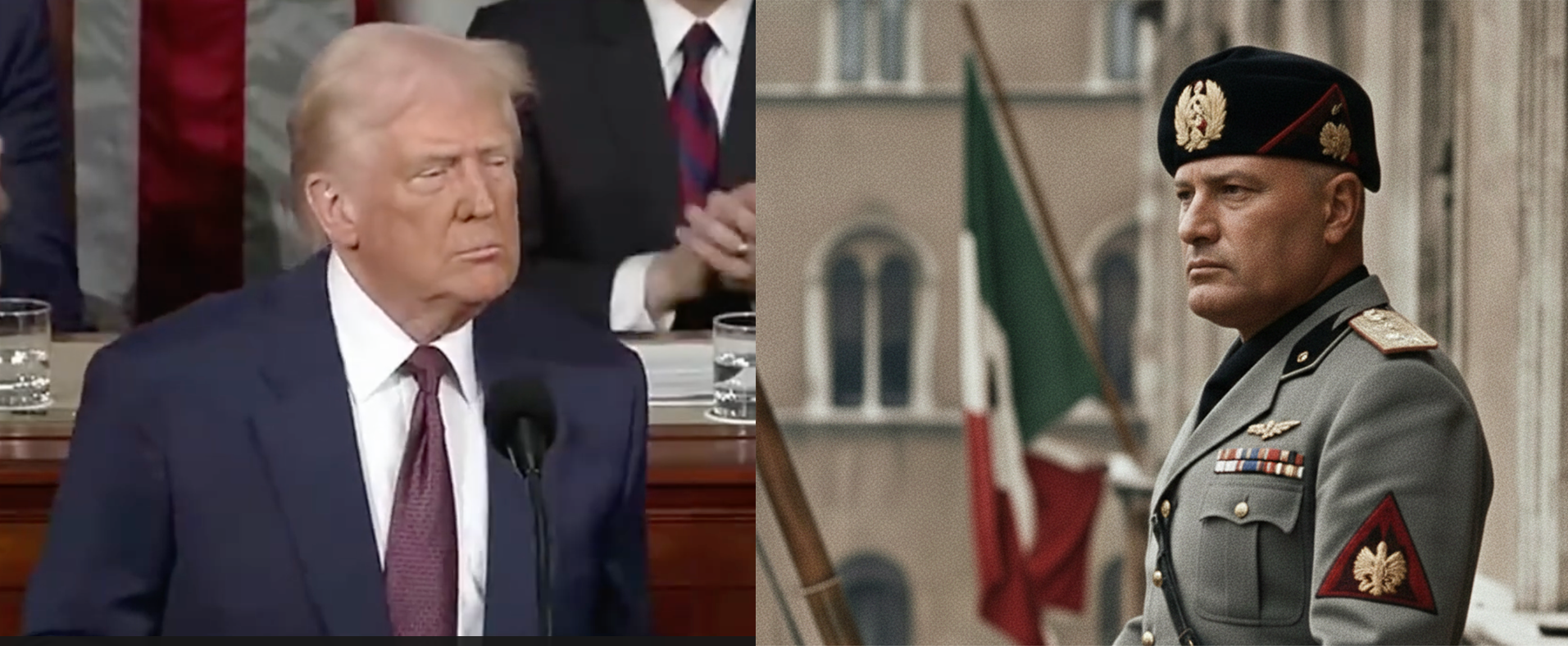
What I kept noticing instead was a different kind of stillness. Chin fractionally raised. Eyes heavy-lidded, cast slightly downward. Not performing gratitude, not reaching back toward the crowd — but simply standing there receiving, the way you might accept tribute that you have already determined is your due. Less “thank you” and more “yes, continue.”
A pose, in other words. A studied, deliberate, architectural pose.
I pulled up the side-by-side almost by accident, and then I sat with it for longer than I expected to.
There’s something almost technical to observe here, if you can set aside the very large question of whether the comparison is fair. The chin-raise. The deliberate weight placed on stillness as a form of authority. The half-lidded gaze that says: I am not moved by your applause, but I will permit it. Mussolini was, among his many catastrophic qualities, a gifted student of the theatrics of power. He understood that the body could make an argument the mouth didn’t need to articulate. The balcony pose. The held jaw. The refusal to look grateful.
Power, he seemed to believe, should never appear to be asking for anything.
Now. I am not calling anyone Mussolini. That comparison, deployed casually, has a way of collapsing under its own weight — it papers over real historical specificity, offends people who deserve not to be offended, and usually ends the conversation rather than advancing it. So let me be precise about what I am actually saying.
I am saying that the vocabulary of strongman aesthetics is a real thing. It has a grammar. It has recurring gestures. And those gestures have been consciously or unconsciously absorbed and reproduced by politicians who want to project a particular kind of dominance — not the democratic kind, which is consensual and a bit ungainly, but the imperial kind, which is not.
Whether any of this is intentional is almost beside the point. The pose works on audiences independent of what the poser intends. The body communicates before the brain catches up. When we see someone stand like that — still, elevated, receiving — something ancient in us registers it as authority, before we’ve had a chance to ask where that authority actually comes from, or whether it was ever legitimately granted.
That’s the part that kept me watching, even after I’d stopped listening.
Words can be fact-checked. Policies can be argued. Lies can be catalogued and corrected, however exhausting that work has become. But a pose — a pose just sits there, doing its quiet work on people who would swear they weren’t being affected by it.
I’m not sure I have a tidy conclusion for you. I didn’t finish the speech. I didn’t read the transcript. What I have is an image I can’t quite put down, of two men separated by about ninety years, an ocean, and an history standing in front of crowds in more or less the same way — chin up, eyes down, perfectly, immovably still.
Waiting, it seems, for history to catch up with how they already see themselves.
· · ·
If this landed for you — or if you think I’ve gotten it entirely wrong — the comments are open. I’m genuinely curious what you saw, if you made it further through the evening than I did.
FTS
Join us on our podcast Specifically for Seniors, where satire meets substance and storytelling sparks civic engagement. Each episode dives into topics like authoritarianism, political spectacle, environmental justice, humor, history and even fly fishing and more—layered with metaphor, wit, and historical insight. We feature compelling guest interviews that challenge, inspire, and empower, especially for senior audiences and civic storytellers. Listen to the audio on all major podcast platforms, watch full video episodes on YouTube, or explore more at our website.
Let’s keep the conversation sharp, smart, and unapologetically bold