The Psychology of Obsession: What Science Tells Us About Anti-LGBTQ+ Legislators
Approximately 1,325 words — 5–6 minute read
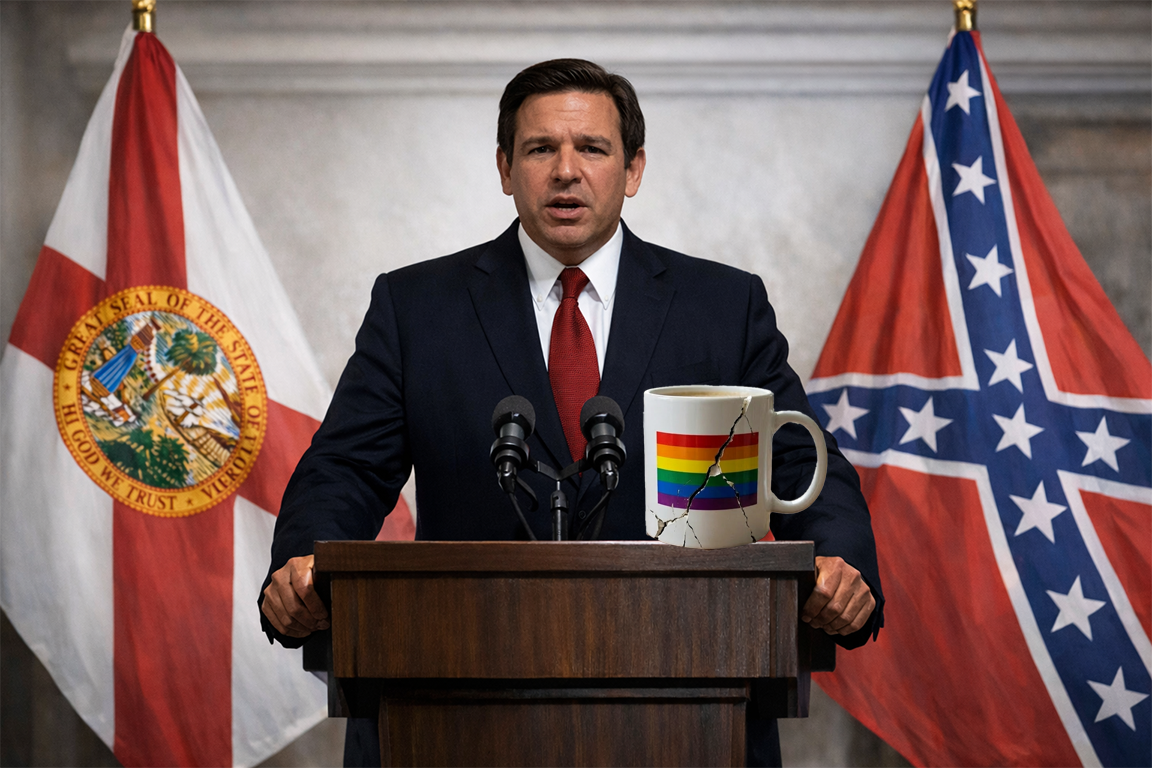
Florida Governor Ron DeSantis has spent the better part of a decade making the lives of LGBTQ+ people the centerpiece of his political identity. This week alone, the Florida House passed an anti-diversity bill so broad that a rainbow image on a government employee’s coffee cup could constitute a violation. A Pride Flag Ban — introduced for the fourth consecutive year — would strip LGBTQ+ visibility from every public building in the state. And in the detail that crystallizes exactly what this is about: while the bill eliminates Pride imagery, it explicitly protects the Confederate flag.
Florida is not an outlier. It is the leading edge. Across 42 states in 2026, 738 bills targeting LGBTQ+ and transgender people are under consideration — the sixth consecutive record-breaking year. In 2015, that number was 21. The escalation is not organic. It is engineered.
So here is the question this piece asks — grounded not in politics but in peer-reviewed science:
What is actually driving this obsession? And what does it say about the people behind it?
Religion Is Not an Explanation. It Is Part of the Problem.
Political commentary typically grants religious conviction a special exemption — sincere belief treated as a more legitimate category of objection than mere prejudice. That exemption is unearned and should be revoked.
The Christianity that Jesus actually taught is built on unconditional love, radical kindness, and selfless service. The Golden Rule. Care for the vulnerable. Forgiveness without condition. Jesus spent his ministry among the marginalized — the sick, the poor, the social outcasts — and reserved his sharpest condemnation for the powerful who used religious law to oppress them. By any honest reading, legislators invoking Christianity to target LGBTQ+ people are not following Jesus. They are doing precisely what he condemned: weaponizing religious authority against the vulnerable. They are practicing the religion of the Pharisees he argued against — rule-based, exclusionary, obsessed with other people’s bodies and behavior.
But hypocrisy is only part of it. Religious objections to LGBTQ+ people are not moral truths handed down from a neutral authority. They are interpretations — selectively chosen, inconsistently applied — by institutions that used identical scriptural logic to defend slavery, the subjugation of women, antisemitism, and racial segregation. The same machinery that produced theological defenses of American chattel slavery produces anti-gay theology today. The texts haven’t changed. The machinery hasn’t changed. Only the target has.
Calling something a religious belief does not make it something other than fear and prejudice. It simply gives fear and prejudice better legal cover. The harm to the people targeted — their mental health, their safety, their families — is identical to any other form of institutionalized bigotry. And as the science below makes clear, religious framing is frequently not even the underlying cause. It is a layer of cover draped over a psychological mechanism that operates with or without scripture. Shame-based religion is often where that mechanism begins.
What the Science Actually Says
In April 2012, Scientific American reported on landmark research by Netta Weinstein, Richard Ryan, and colleagues, published in the Journal of Personality and Social Psychology. Their findings reframed the question of anti-gay hostility entirely.
Using split-second reaction time tests that measure subconscious responses — the kind that register before the conscious mind can intervene — the researchers found that individuals expressing the most intense public hostility toward gay people also showed the highest levels of private, implicit same-sex attraction. The gap between what people said about their sexuality and what their unguarded responses revealed was, for a significant subgroup, dramatic.
It was precisely this group — those with the largest gap between stated and implicit orientation — who were most likely to support anti-gay legislation, assign harsher punishments to gay people, and exhibit the most aggressive anti-LGBTQ+ attitudes overall. The hostility wasn’t incidental to the repression. It was produced by it.
Upbringing proved critical. Participants from controlling, authoritarian households showed the largest discrepancy between their stated and implicit identities. In environments — including deeply religious ones — where same-sex attraction is treated as shameful or sinful, acknowledging even a trace of it becomes dangerous. So it gets buried. And buried things find other ways out.
Co-author Richard Ryan put it plainly: people who are at war with themselves turn that conflict outward. Those threatened by gay and lesbian people are often fearing their own impulses. They doth protest too much. At the scale of 738 bills a year, across 42 states, for six consecutive record-breaking years — that is not policy disagreement. That is a psychological emergency expressed as legislation.
The Pattern the Science Predicts
The documented list of vocally anti-gay public figures caught in same-sex behavior is long enough, and consistent enough, to constitute a phenomenon rather than a series of coincidences. Ted Haggard — evangelical pastor, prominent opponent of same-sex marriage — caught in a gay sex scandal. Larry Craig — US Senator with a consistent anti-gay voting record — arrested for soliciting sex from an undercover male officer in an airport bathroom. George Rekers — co-founder of the Family Research Council — photographed returning from Europe with a male escort hired from Rentboy.com. Wesley Goodman — Ohio state representative, champion of “family values” legislation — resigned after having sex with a man in his own government office. Ralph Shortey — Oklahoma state senator, author of anti-transgender bathroom legislation — charged with soliciting prostitution from a 17-year-old boy.
Each case in isolation is hypocrisy. Together, they are exactly what the research predicts: the ferocity of public condemnation in direct proportion to the intensity of private conflict. The cycle is self-reinforcing — shame-based religion produces repression, repression produces outward aggression, that aggression re-encodes as righteous conviction, which produces the next generation of repression. It is not coincidence. It is a mechanism.
The Cynics, the Zealots, and What It Tells Us
Not every legislator sponsoring these bills is wrestling with their own sexuality. Some are simply calculating. Manufacturing fear about LGBTQ+ people is politically efficient — it activates a base, raises money, builds a brand. Trans people, representing roughly 0.6% of the population, make an ideal target precisely because most Americans don’t personally know one. That unfamiliarity is a blank canvas. The “groomer” rhetoric, the bathroom obsession, the framing of gender-affirming care as “mutilation” — none of this reflects organic public concern. It is a coordinated moral panic, deployed by people who know exactly what they are doing.
DeSantis built his entire 2024 presidential campaign on this architecture. When it collapsed, it wasn’t because the strategy was wrong — it was because he miscalculated how far it could travel beyond the base. The infrastructure remains fully intact.
Whether the motivation is repression or calculation, the legislation is the same and the damage is real. LGBTQ+ youth in states with more hostile laws have measurably higher rates of depression, anxiety, and suicidal ideation. Behind every one of those 738 bills is an actual person — a trans teenager trying to understand who they are while their government mobilizes against their existence, a gay couple watching the legal architecture of their life erode, an employee in a state that now explicitly protects a coworker’s right to demean them.
The most important thing the science tells us is this: the men most consumed by legislating against LGBTQ+ lives reveal far more about themselves than about the people they target. The obsession, the escalation, the years of returning to the same subject with the same fury — that is not governance. It is not faith. It is not morality.
It is a mirror. And they are terrified of what they see in it.
Sources: Scientific American, “Homophobes Might Be Hidden Homosexuals,” April 10, 2012; Weinstein, Ryan et al., Journal of Personality and Social Psychology, 2012; Trans Legislation Tracker 2026; ACLU Legislative Tracker 2026; Equality Florida 2026 Bill Tracker; Human Rights Campaign State Equality Index.
FTS
Join us on our podcast Specifically for Seniors, where satire meets substance and storytelling sparks civic engagement. Each episode dives into topics like authoritarianism, political spectacle, environmental justice, humor, history and even fly fishing and more—layered with metaphor, wit, and historical insight. We feature compelling guest interviews that challenge, inspire, and empower, especially for senior audiences and civic storytellers. Listen to the audio on all major podcast platforms, watch full video episodes on YouTube, or explore more at our website.
Let’s keep the conversation sharp, smart, and unapologetically bold