Trump scraps skyscraper library — Mar-a-Lago to be razed for golden pyramid "bigger than anything Egypt ever built"
Trump plans presidential library skyscraper with two gold statues of himself
President Donald Trump shared the first images of his planned presidential library in downtown Miami, posting a short video Monday night that depicts a skyscraper that appears to be about 50 stories tall and filled with reconstructions of parts of the White House, military vehicles and at least two gold statues of Trump.
The 100-second video, which Trump posted on his Truth Social platform, offers a series of views of the planned Donald J. Trump Presidential Library, represented as a gleaming glass and gold structure that would dwarf nearby buildings, topped by a red-white-and-blue spire.
Washington Post March 30, 2026
Word Count ~ 1500 7 min read
Just one day after images emerged of a proposed Trump Presidential Library — a gleaming 50-story Miami skyscraper flanked by two gold statues of the 47th president — sources close to the White House say the design is already on the scrap heap. Literally.
The president, according to insiders, reviewed the Miami tower renderings overnight and found them “too modest.” A skyscraper, he reportedly told advisors, is something any Manhattan developer can build. What he has in mind now is something “for the ages. For eternity. For a god on earth.”
The site: Mar-a-Lago, his storied Palm Beach estate, perched on a slim barrier island between the Intracoastal Waterway and the Atlantic Ocean. The current structure — a 128-room Mediterranean Revival mansion built in 1927 — would be demolished to make way for the new monument. “The old place was beautiful, really beautiful,” the president is said to have noted, “but it’s not a pyramid.”
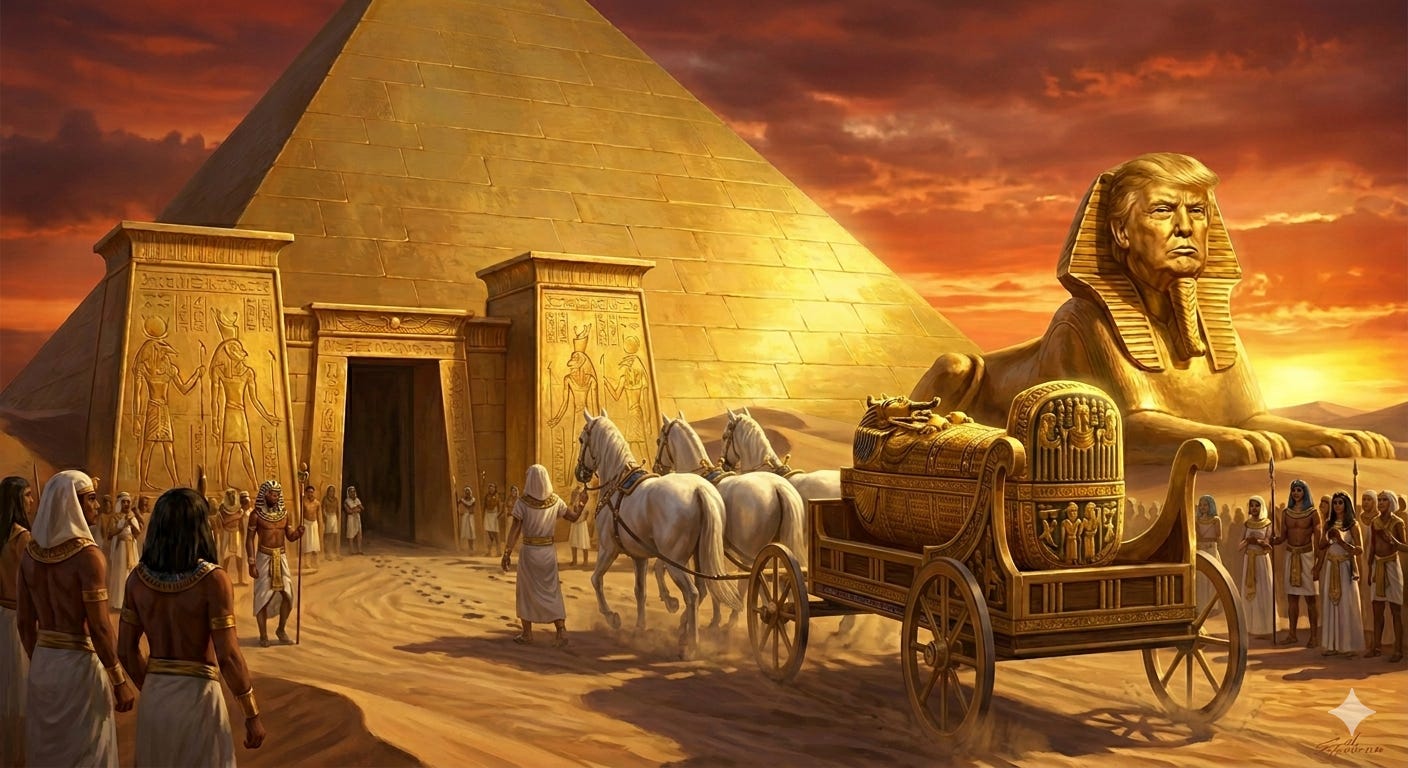
“It’ll be the biggest pyramid ever seen. No pyramid will be bigger. All solid gold. Right there on the water in Palm Beach. The Egyptians, very smart people, but they didn’t have oceanfront.”
— President Trump, as relayed by sources familiar with the conversation
Flanking the pyramid’s eastern face — oriented, naturally, toward the rising sun over the Atlantic — would be a colossal golden sphinx bearing the president’s likeness. Early sketches, described by one source as “napkin-level but very confident,” show the sphinx reclining where Mar-a-Lago’s famous croquet lawn currently sits, gazing serenely toward the sea.
The Palm Beach Town Council, which has historically scrutinized even minor renovations to the estate’s exterior, was not immediately available for comment on the proposed replacement of a century-old national historic landmark with a solid-gold ancient Egyptian monument.
THE THREE VISIONS, COMPARED
Original plan (Sunday)
~50-story skyscraper
Downtown Miami
Two gold statues
Glass & steel
New construction site
Revised vision (Monday)
“Biggest pyramid ever”
Palm Beach, oceanfront
Golden sphinx
Solid gold
Mar-a-Lago demolished
Ancient precedent
Great Pyramid of Giza
Egyptian desert
Limestone & granite
Pharaoh Khufu
No ocean views
What lies within: the sarcophagus chamber
Here is where the pyramid concept decisively surpasses anything a 50-story Miami tower could ever offer. A skyscraper has floors, lobbies, and gift shops. A pyramid has a burial chamber — and sources say the president’s inner circle has already begun, enthusiastically, to discuss what should accompany the sarcophagus.
The ancient Egyptians believed the pharaoh would need in the afterlife everything he had enjoyed in this one. Servants, food, gold, weapons, chariots — all entombed alongside the royal body so that death would be merely an inconvenient change of address. Trump’s advisors, thinking along similar lines, have reportedly floated a burial assemblage of almost incomprehensible grandeur.
Among the items said to be under consideration for interment: the gifted Air Force One; the original signed copies of every executive order from both administrations, bound in leather embossed with 24-karat gold leaf; a complete set of his preferred diet soda, hermetically sealed for eternity; every framed magazine cover in which he has appeared, stacked floor to ceiling; a scale model of the completed border wall; a gilded recliner; an internet connection to Truth Social so he can announce his arrival at St. Peter’s gate and, according to one source who spoke on condition of anonymity, “at least one television — a big one — tuned permanently to a favorable cable news channel.”
There is also, insiders say, serious discussion of enshrining the scorecard from what the president has described as his greatest round of golf — the details of which remain, as ever, subject to independent verification. A MAGA hat, almost certainly the first one ever produced, would occupy a place of honor in a sealed crystal case at the foot of the sarcophagus.
Compare this to what the Miami tower could have offered: a reading room, some archival boxes, a few interactive displays, and the two gold statues out front. Dignified, certainly. But lacking the eternal, cosmological ambition of a burial chamber stocked for the next life. The pyramid, in this sense, is not merely bigger — it is philosophically superior. It presupposes not just a legacy, but a sequel.
The practical challenges, briefly considered
Engineers consulted informally by this publication raised several concerns, none of which appeared to dampen the president’s enthusiasm. Palm Beach Island sits approximately four feet above sea level at its highest point, which presents foundational challenges for a structure that, if built to surpass the Great Pyramid’s 481-foot original height, would be roughly 120 times taller than the island itself. Rising seas, hurricane-force winds, and the soft limestone geology of South Florida were also noted.
On the matter of cost: solid gold at current commodity prices of roughly $4,600 per troy ounce would make even a modestly sized pyramid the most expensive construction project in the history of human civilization. A structure matching the Great Pyramid’s volume in solid gold would be worth more than $400 trillion — nearly four times the GDP of the United States. The president’s team did not respond to questions about financing.
What it would have going for it, however, is unquestionably the best ocean views of any pyramid on earth. The Egyptians, as the president correctly noted, did not have oceanfront.
What was there before
It is worth pausing to note what would be lost. Mar-a-Lago — “Sea to Lake” in Spanish — was built by cereal heiress Marjorie Merriweather Post between 1924 and 1927, designed in a Hispano-Moorish-Venetian style with 58 bedrooms, 33 bathrooms, and a 29-foot-high living room with a hand-painted ceiling. The estate was designated a National Historic Landmark in 1980. Trump purchased it in 1985 for $10 million.
It has served as the president’s de facto Southern White House for two administrations, hosting foreign leaders, cabinet meetings, and an uncountable number of Saturday night dinners. To demolish it in favor of a solid gold pyramid would represent, at minimum, an unusually bold architectural statement.
The pharaohs of ancient Egypt did not typically tear down their own palaces to build their tombs. But then, they also lacked the president’s well-documented willingness to think big.
A monument to the self: what this all really means
Strip away the satire for a moment, and something genuinely revealing remains. The progression from skyscraper to pyramid is not random. It is the logical endpoint of a political identity built, from its very first escalator descent, on the premise that scale equals legitimacy — that the biggest, the tallest, the most gold is also the most true.
Presidential libraries have always carried an element of ego. Every former president wants to control his own narrative, to house his papers in an edifice that flatters his legacy. But they have also, traditionally, gestured outward — toward the public, toward scholarship, toward a conception of service larger than the man himself. The Kennedy Library faces the sea in Boston. The Lincoln Memorial faces a reflecting pool. Even the most grandiose of them are, at their core, invitations.
A solid gold pyramid with a sphinx in one’s own likeness, stocked with one’s personal effects for use in the afterlife, is something categorically different. It is not an invitation. It is a declaration. It says: I was here, I was enormous, and I intend to remain so permanently, in this dimension and the next.
Psychologists who study narcissistic personality structures note that one of its hallmarks is the inability to conceive of a world in which the self is not the organizing principle — a compulsive need to make the external environment mirror the internal sense of grandiosity. Most people who exhibit these tendencies do so quietly, in their homes or offices. A small number become politicians. A smaller number still get to build things. Very rarely, across all of human history, has someone had the combination of resources, temperament, and cultural moment to attempt to make the grandiosity literal — to actually construct, in gold and stone, the monument that most of us only carry in our heads.
The pharaohs understood this impulse perfectly. They simply had the good sense not to also run a social media platform while doing it.
Whether the pyramid gets built is, ultimately, beside the point. The fact that it was imagined — that the first instinct upon contemplating one’s own legacy was not a library or a park or a foundation, but a tomb fit for a deity, stocked with golf scorecards and cable television — tells us something that no amount of marble and gold could obscure. The monument, in the end, is the man.
FTS
Join us on our podcast Specifically for Seniors, where satire meets substance and storytelling sparks civic engagement. Each episode dives into topics like authoritarianism, political spectacle, environmental justice, humor, history and even fly fishing and more—layered with metaphor, wit, and historical insight. We feature compelling guest interviews that challenge, inspire, and empower, especially for senior audiences and civic storytellers. Listen to the audio on all major podcast platforms, watch full video episodes on YouTube, or explore more at our website.
Let’s keep the conversation sharp, smart, and unapologetically bold