What Neanderthals Can Teach Us About Modern Leadership
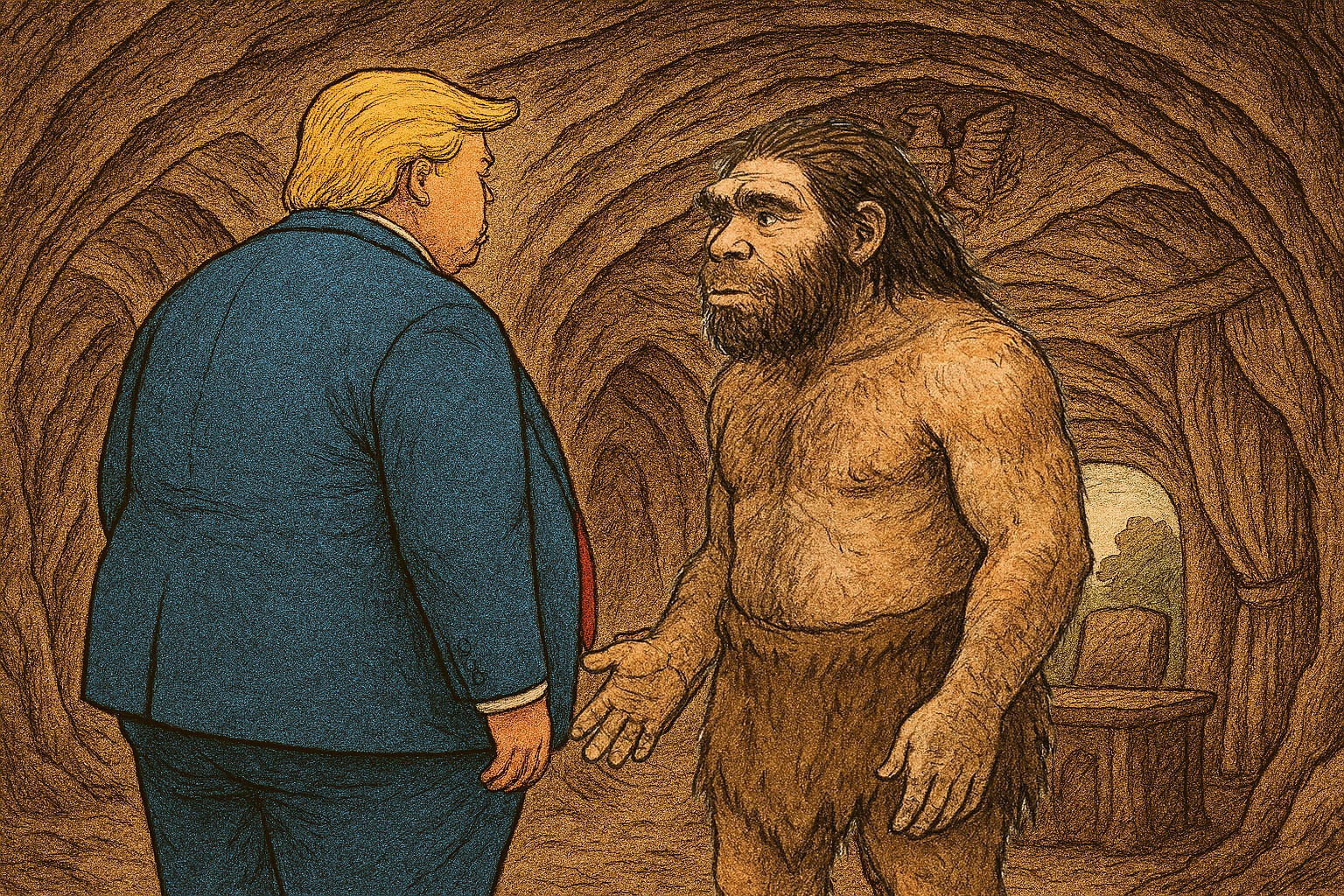
The Year in Neanderthals
They drew with crayons, possibly fed on maggots and maybe even kissed us: Forty millenniums later, our ancient human cousins continued to make news.
Barely three decades ago, these ancient hominids were still being widely depicted as knuckle-dragging brutes that were too dimwitted for moral or religious concepts, probably lacking language and behaviorally less advanced than modern humans. The picture changed considerably in 2010 after the Max Planck Institute published the complete Neanderthal genome, which revealed that people of European or Asian descent possess as much as 4 percent Neanderthal DNA, indicating extensive, past interbreeding between the two hominid groups.
New York Times January 6, 2026
For generations, we dismissed Neanderthals as brutish, primitive versions of ourselves—evolutionary dead ends who lacked the sophistication to survive. The stereotype was powerful: club-wielding cavemen, incapable of complex thought, doomed by their own limitations.
Recent archaeological discoveries have shattered this myth entirely. And in doing so, they’ve revealed something uncomfortable about our current moment: our extinct cousins from 40,000 years ago demonstrated more sophisticated leadership, cultural transmission, and social intelligence than the autocratic leader currently occupying the White House.
This isn’t hyperbole. It’s a matter of examining the evidence.
Neanderthals deliberately crafted ochre crayons for symbolic purposes—creating art, marking their world, communicating meaning. They resharpened these tools repeatedly, refining them for continued use. This wasn’t idle decoration. It represented symbolic thought, cultural transmission, and the teaching of skills across generations.
Our current president, by contrast, used a Sharpie to alter an official NOAA hurricane map in 2019, falsely extending Hurricane Dorian’s projected path into Alabama after he had incorrectly claimed the state would be hit. The alteration of official government weather forecasts is illegal under federal law. The incident damaged NOAA’s credibility and undercut public trust in the agency’s apolitical weather forecasting.
One species used marking tools to create and communicate truthfully. The other used them to alter reality, override scientific expertise, and pressure government agencies into backing false claims to protect ego rather than public safety.
Research suggests Neanderthals may have consumed maggots from cached meat—a sophisticated food preservation strategy showing planning, patience, and adaptation. They stored meat, let it age in controlled ways, and possibly benefited from protein-rich larvae. It demonstrates delayed gratification and practical food science.
Meanwhile, the current president’s documented consumption patterns tell a different story. According to Republican National Committee Chairman Joe Gruters, he consumed hot fries, a Filet-O-Fish, a Quarter Pounder, and a Big Mac in a single sitting during the 2024 campaign, apparently combining two sandwiches together. Former aides documented that his campaign plane stocked what they called four major food groups: McDonald’s, Kentucky Fried Chicken, pizza, and Diet Coke.
Our extinct cousins showed more dietary wisdom and impulse control 40,000 years ago than a modern leader approaching 80. One diet reflects adaptation to environmental challenges. The other reflects unlimited access meeting zero restraint.
Evidence suggests Neanderthals likely engaged in kissing behavior, with research indicating an 84% probability. They interbred with early humans, forming complex social bonds that transcended group boundaries. This reflects consent, mutual care, and sophisticated social intelligence.
The current president, however, maintained a decade-plus friendship with convicted sex trafficker Jeffrey Epstein. In 2002, he told New York magazine he had known Epstein for fifteen years, describing him as a “terrific guy” and noting “he likes beautiful women as much as I do, and many of them are on the younger side.” In a 2019 interview, Epstein described him as his “closest friend for 10 years.”
Neanderthals 40,000 years ago demonstrated more ethical social behavior than a modern leader who surrounded himself with someone trafficking children, then spent years trying to distance himself from documented evidence of their close friendship.
The ochre crayons weren’t just art supplies—they represent investment in the future. Neanderthals were teaching others how to make them, refining techniques, passing down both practical skills and symbolic practices. They understood that knowledge must be preserved, taught, and transmitted to survive.
The current president signed an executive order in March 2025 to dismantle the Department of Education. His administration shifted work from offices placed at the department by Congress when it was created in 1979 to other agencies without Congressional consent. The department has historically played a critical role in protecting civil rights, promoting equity, and providing opportunities for all students.
Where Neanderthals showed foresight—making tools that could be resharpened and reused, teaching skills that would outlast individuals—the current administration attacks experts, dismisses scientific consensus, guts educational infrastructure, and proudly broadcasts disdain for reading and learning.
Neanderthals survived for hundreds of thousands of years across dramatically shifting climates and environments. They adapted hunting strategies to different prey, developed region-specific tool traditions, innovated new technologies when conditions changed, and transmitted these adaptations across populations. Their survival depended on flexibility, experimentation, and the ability to respond to new challenges with new solutions.
The current administration, by contrast, is implementing Project 2025—a political initiative published in April 2023 by the Heritage Foundation with the goal of reshaping the U.S. federal government by consolidating executive power. Stephen Miller, a key architect of immigration policy during the previous administration, is a major figure in Project 2025. Russell Vought authored sections focused on expansion of presidential powers, outlining aims to purge the “sprawling federal bureaucracy” and concentrate more power in the presidency.
It’s a 922-page instruction manual that assumes every problem has the same solution: consolidate power, purge dissent, eliminate expertise. Miller’s immigration obsessions from 2017 become the template for 2025. Vought’s executive power theories from one context get copy-pasted into every situation. There’s no learning, no adaptation, no response to new information or changing conditions.
This isn’t governance. It’s ideological franchising.
Neanderthals went extinct, but not from lack of adaptability—they survived ice ages, volcanic winters, and massive environmental shifts for over 300,000 years. Project 2025 and the current administration represent what actually kills species: rigid adherence to a single strategy even when conditions change, inability to incorporate new information, and elimination of the very diversity that enables adaptation.
The real lesson from Neanderthal research isn’t about finding political parallels—it’s about recognizing that our long-extinct cousins were far more sophisticated, empathetic, and culturally complex than once believed. They were not brutish primitives but thoughtful beings capable of art, intimacy, innovation, and the transmission of knowledge across generations.
Which makes the comparison to our current autocratic leadership all the more damning.
We’ve somehow regressed. Our extinct cousins were using their crayons more responsibly 40,000 years ago than our current leaders use Sharpies today. They showed more dietary wisdom, more ethical social behavior, more commitment to education and cultural transmission, and more cognitive flexibility than the administration currently running the most powerful nation on Earth.
It’s a civilizational reversal: our ancient cousins were building the foundations of culture. Our current leaders are actively tearing them down.
The question isn’t whether Neanderthals were smart enough to survive. It’s whether we are.
The irony writes itself: modern humans spent centuries dismissing Neanderthals as inferior. Now we’re watching leadership that makes those extinct cousins look downright enlightened.
FTS
This space isn’t meant to be a monologue. It’s a dialogue — sharp, satirical, and sometimes uncomfortable. Do you agree with the stance? Disagree with the framing? See illusions I’ve missed? Add your voice. Comment, challenge, expand, dismantle. The sharper the exchange, the clearer the vision. Disillusionment isn’t passive; it’s participatory.
Join us on our podcast Specifically for Seniors, where satire meets substance and storytelling sparks civic engagement. Each episode dives into topics like authoritarianism, political spectacle, environmental justice, humor, history and even fly fishing and more—layered with metaphor, wit, and historical insight. We feature compelling guest interviews that challenge, inspire, and empower, especially for senior audiences and civic storytellers. Listen to the audio on all major podcast platforms, watch full video episodes on YouTube, or explore more at our website.
Let’s keep the conversation sharp, smart, and unapologetically bold.