POTUS Admits Oath of Office Was "Total Prank," Fingers Were Crossed During "So Help Me God" Part
In a stunning NYT interview on January 11, 2026, President Trump expressed his biggest regret from 2020: not ordering the National Guard to seize voting machines. Though he graciously acknowledged the Guard might lack “the sophistication” for a proper coup. How humble! Most aspiring autocrats never admit their military isn’t smart enough to overthrow democracy.
Let that sink in while I laugh myself sick.
Most politicians hide authoritarian impulses behind euphemisms. But Trump just announces “I should have used soldiers to steal ballot boxes, and my only regret is they weren’t competent enough.” Finally, a politician who tells it like an autocrat!
The Constitution insists on tedious things like separation of powers, federalism, and due process. Trump identified the problem: it keeps getting in his way.His solution? Ignore it! Why didn’t the Founders think of that? Oh right—they specifically designed it to prevent people like Trump. Awkward.Consider his revolutionary theory: states are “merely an agent for the Federal Government” who “must do what the President tells them.”
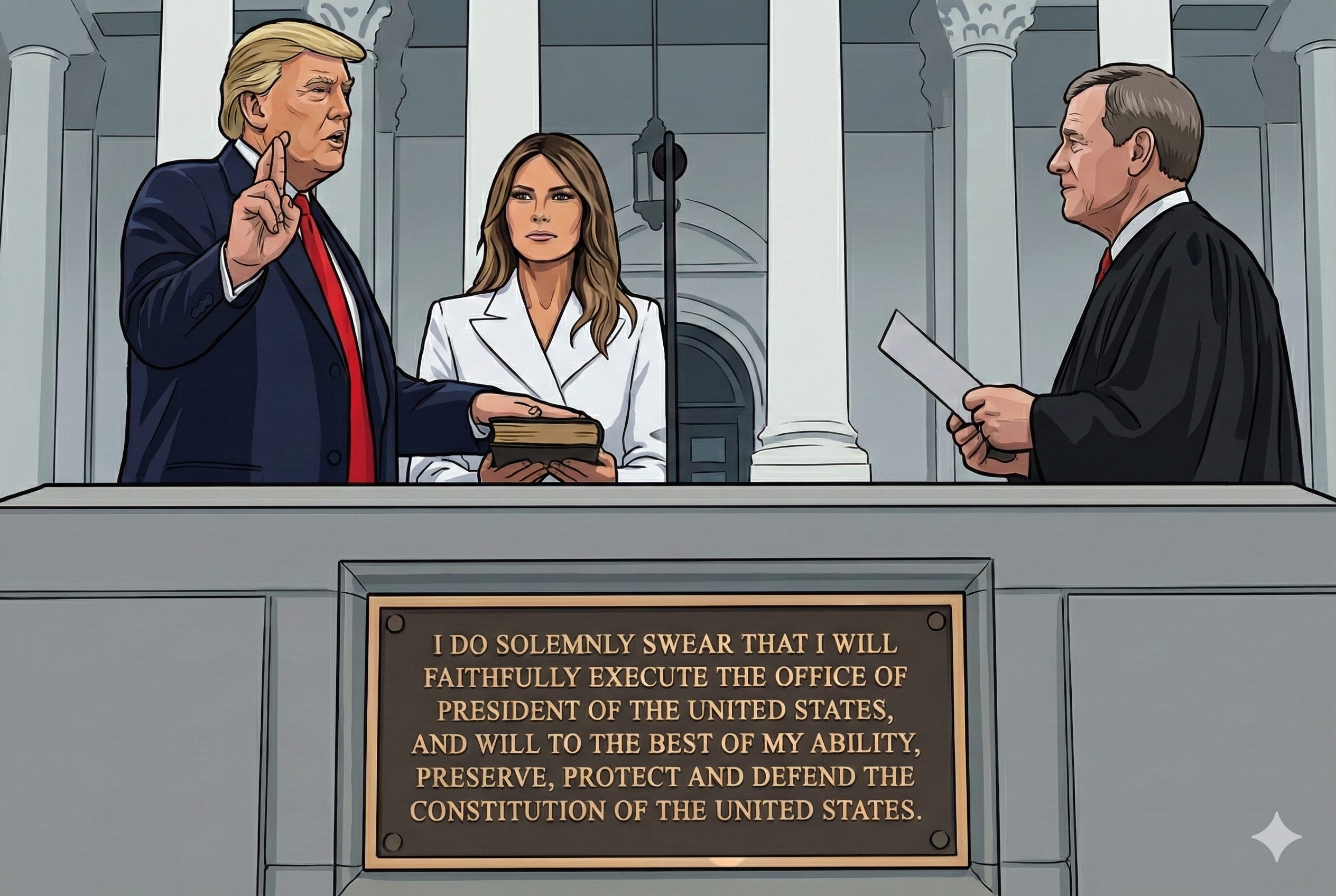
Madison sweated through Philadelphia summer 1787 creating federalism. But Trump discovered he was WRONG. States are just presidential helpers! Who knew? Certainly not that constitutional amateur James Madison.Trump swore to “preserve, protect and defend the Constitution.” But that’s just ceremonial! It’s not like it creates actual obligations transcending political loyalty.
Sure, Alexander Hamilton in Federalist 65 said impeachable offenses “relate chiefly to injuries done immediately to the society itself.” But what does Hamilton know? He never had to worry about mean tweets. Trump found a brilliant loophole: if you publicly admit you should have violated the Constitution, you’ve been honest about wanting to break it. Constitutional scholars hate this one weird trick!
Nearly one-third of Americans voted by mail in 2024. Unacceptable! Trump’s solution: announce plans to eliminate mail ballots and voting machines before the 2026 midterms.
Sure, the Constitution explicitly gives states—not presidents—power to run elections. But that was 1787, before we had a president smart enough to realize he should do whatever he wants.
Even better: his March 2025 executive order commanded the Attorney General to prevent states from counting ballots arriving after Election Day—even when state law permits this for military ballots! Support our troops by not counting their votes! The U.S. Postal Service helped by announcing it may not postmark mail when received—potentially disenfranchising thousands in 18 jurisdictions. Government efficiency!
Remember Trump’s 2020 call to Georgia’s Brad Raffensperger: “I just want to find 11,780 votes”? How charmingly unsophisticated!
Trump evolved! He learned attempting coups after losing is hard. So now he’s attempting to engineer victories before voting happens by:
Building federal databases of voter information states legally can’t share
Expressing public regret about not using military force
It’s the difference between a pickpocket and someone who steals from banks, makes bank-robbing legal, then claims objectors are divisive.
Trump warned Republicans that if Democrats win Congress, they’d “find a reason to impeach me.” He’s framing democratic accountability as illegitimate partisan attack. Beautiful circular logic: I must rig elections to avoid being held accountable for rigging elections. As one analysis noted: “By presenting potential impeachment as justification for election manipulation, Trump is arguing that avoiding constitutional accountability justifies subverting constitutional processes.”
It’s a snake eating its tail while trying to end democracy and complaining that people noticing are being uncivil.
Republican members heard their president express regret about not staging a military coup and responded with a shrug registering on the Richter scale. They face an impossible choice: uphold their oath to the Constitution or keep their $174,000 salary and avoid mean tweets The Constitution is old parchment. But congressional salary? That’s real money! The Founders would understand.
Hamilton said impeachable offenses threaten “the constitutional order.” But he never had to worry about losing a primary to a QAnon supporter! The Framers used “high crimes” to encompass abuses threatening constitutional order even without criminal violations. How naive! They never considered future congresspeople might find constitutional defense politically inconvenient!
For decades, Republicans championed states’ rights against federal overreach. The Tenth Amendment was their bedtime story.
But when Trump wants to: Override state election laws, Ban state-administered mail voting, Seize state election equipment with troops, or Force states to obey because they’re “merely agents”? Response? Crickets. Not even loud crickets. Quiet, embarrassed crickets reconsidering their life choices. Turns out “states’ rights” only matters when states do Republican-approved things. When states might elect Democrats? Suddenly states are “agents” who “must do what the President tells them.” States have rights—until they don’t! The Tenth Amendment matters—except when it doesn’t! This is principled consistency at its finest!
Where are the Tea Party warriors screaming about federal overreach? Where are the “Don’t Tread on Me” folks? They’re all fine with this! Turns out the “tyranny” they feared was only Democrats doing things The Framers created the presidential oath as “the core obligation of the office.” They designed impeachment for presidents who abuse power and threaten “the constitutional order.”
Now we have a president who:
Expresses regret over not deploying military to seize election equipment
Demonstrates fundamental disrespect for constitutional limits
Shows contempt for electoral processes legitimizing democratic government
Expresses willingness to use military force against state governments
Poses active threat to future elections through ongoing reshaping efforts
The Framers designed the Constitution to prevent exactly this. They’d be impressed by how thoroughly Trump has attacked every safeguard they created. It’s like watching someone systematically disarm a security system—impressive in a horrifying way.
Every time Congress fails to check presidential overreach, it cedes more power to the executive branch. If a president can openly express regret over not using military force to overturn an election—without consequence—then what meaningful check on presidential power remains? Republican Congress members should ask: “Do I want a future Democratic president to have this unchecked power? Because that’s what my silence creates.” But they can’t think that far ahead. They’re calculating whether they’ll survive the next primary, get Trump’s endorsement, get invited on Fox News.
When Congress refuses to use impeachment in the face of clear constitutional violations, they’re not protecting their party—they’re dismantling their institution. Correct! Congress is committing institutional suicide to protect Trump. Trading constitutional powers for temporary political safety. Becoming a rubber stamp for executive overreach. Willingly. Enthusiastically. Proudly. Future Congresses will find their power diminished, constitutional role weakened, ability to check presidents neutered—all because current Republicans decided defending Trump mattered more than defending their own institutional authority.
Why would you want constitutional powers when you can have Trump’s approval instead?
The Constitution provides for impeachment for “Treason, Bribery, or other high Crimes and Misdemeanors.” The Framers used “high crimes” to encompass abuses threatening constitutional order, even without criminal statute violations. Expressing regret over not deploying military to seize election equipment—effectively regretting not attempting a coup—represents exactly the abuse impeachment was designed to address. The central question: The question isn’t whether this rises to impeachable conduct. The question is whether we still believe the Constitution means what it says.
Spoiler: Republicans answered that question. No. They don’t believe the Constitution means what it says. They believe it means whatever is politically convenient. When Democrats are in power, the Constitution is sacred text requiring strict interpretation. When Trump is in power, the Constitution is more of a guideline. A suggestion. A vibe.
Here’s where I’m supposed to offer hope. Suggest maybe Republicans will find their spines and do the right thing. Remind you democracy has survived before.
Where I channel Lincoln: “Let us have faith that right makes might, and in that faith, let us, to the end, dare to do our duty as we understand it.”
But I’m writing satire, not delusional fantasy.
The truth: we’re watching a political party decide winning matters more than how you win. That power matters more than legitimacy. That avoiding short-term political pain matters more than preventing constitutional catastrophe. Trump isn’t hiding his authoritarian impulses. He’s broadcasting them. Building a movement around them. Telling you he wanted to use military to overturn an election, and his only regret is that he didn’t.
Republicans in Congress are enabling him—not despite understanding what he’s doing, but while understanding exactly. They know he’s violating his oath. They don’t care. They know he’s threatening elections. They just hope he’s threatening Democratic victories. They know when they swore to defend the Constitution “against all enemies, foreign and domestic,” this moment is what that oath meant. They decided the oath was optional. A formality. Words you say with your hand on a Bible before getting back to keeping your job.
How do we convince a Republican Congress to fulfill constitutional responsibility when the threat comes from a Republican president?
Honest answer? You probably can’t.
You should still try. Contact representatives. Write letters. Build coalitions. Make arguments persistently. Not because it will work—it probably won’t—but because giving up guarantees failure.
But let’s not pretend success is likely. The incentive structure is broken. Right-wing media created alternative reality. The base has been radicalized. Donors decided democracy is negotiable. The party has been captured by personality cult.
Republican Congress members face a choice: defend a president who regrets not using military force to overturn an election, or defend the Constitution they swore to protect.
They chose Trump.
If you live in a Republican district, call your representative. Make them explain their position. Make them own it. Make them tell you to your face that defending this behavior is acceptable. If you have relationships with Republican voters, ask questions: “How would you feel if a Democratic president said this?” Focus on shared values—except oh wait, it turns out those values weren’t actually shared, just convenient rhetorical weapons.
Support Republicans who show courage. Both of them. We’ll find another one eventually. Maybe. Don’t give up on persuasion, because the alternative is worse. But don’t delude yourself about success odds. Make them own this. Make them explain to grandchildren why they stayed silent when a president said he regretted not using military force to overturn an election.
They won’t be able to claim they didn’t know. They won’t say they were misled or things were ambiguous.
Trump told them exactly what he believes and wants to do. The New York Times published the interview. The Washington Post documented his election manipulation. The evidence is documented. The pattern is clear. The threat is explicit.
They chose to enable it anyway.
That’s not a political calculation. It’s a moral failure. A constitutional abdication. A betrayal of their oath. And it should be remembered as such. Every Republican staying silent while Trump expresses regret about not using military force to overturn an election is complicit. Every one voting against impeachment is complicit. Every one making excuses or claiming partisan witch hunt is complicit.
They’re choosing party over country. Power over principle. Trump over the Constitution. When democracy fails—not if, but when, because that’s our trajectory—they bear responsibility for that failure.
In the immortal words of Joseph Welch to Joseph McCarthy: “Have you no sense of decency, sir? At long last, have you left no sense of decency?”
The Constitution provides the remedy. The Framers gave us the tools. Impeachment exists precisely for this scenario—for presidents who abuse power, threaten elections, express regret about not using military force to overturn democratic results. But the remedy only works if people use it. Republicans decided they won’t. Not because the case isn’t clear—it couldn’t be clearer. Not because the threat isn’t serious—it couldn’t be more serious. But because using the constitutional remedy would cost them their seats, power, places in Trump’s favor.
So here we are. A president who regrets not staging a coup. A party that’s fine with it. A Constitution gathering dust. Democracy circling the drain while everyone pretends this is normal. The question isn’t whether this rises to impeachable conduct. The question is whether we still believe the Constitution means what it says.
We have our answer. At least half of Congress decided it doesn’t. The Constitution means whatever keeps them in power. Democratic principles matter until they’re inconvenient. The oath of office is just words at a ceremony before getting back to serving yourself.
And that, dear reader, is how democracies die. Not with a bang, but with a shrug. Not with storm troopers in streets, but with elected officials deciding that defending authoritarian impulses is easier than defending democratic principles. Trump isn’t the disease. He’s the symptom. The disease is a political party that decided winning matters more than how you win, and a population convinced that abandoning constitutional principles is actually patriotism.
Welcome to the endgame. At least the memes will be good.
The beauty of our constitutional system is that it provides remedies for even the gravest abuses of power. Impeachment exists precisely for moments like this—when a president’s actions and statements threaten the foundations of democratic governance itself. Whether that remedy is used depends not on Democrats or Republicans, but on whether enough Americans—across party lines—demand that their representatives place the Constitution above political convenience.
FTS
This space isn’t meant to be a monologue. It’s a dialogue — sharp, satirical, and sometimes uncomfortable. Do you agree with the stance? Disagree with the framing? See illusions I’ve missed? Add your voice. Comment, challenge, expand, dismantle. The sharper the exchange, the clearer the vision. Disillusionment isn’t passive; it’s participatory.
Join us on our podcast Specifically for Seniors, where satire meets substance and storytelling sparks civic engagement. Each episode dives into topics like authoritarianism, political spectacle, environmental justice, humor, history and even fly fishing and more—layered with metaphor, wit, and historical insight. We feature compelling guest interviews that challenge, inspire, and empower, especially for senior audiences and civic storytellers. Listen to the audio on all major podcast platforms, watch full video episodes on YouTube, or explore more at our website.
Let’s keep the conversation sharp, smart, and unapologetically bold.